
In the vast, intricate dance of the global supply chain, there is a pulse that often goes unnoticed. It’s the quiet signals from a pallet in a bustling warehouse, the soft murmur of a medical device in a busy hospital, and the steady digital pulse of a valuable component making its way across the ocean. For decades, the dream of total visibility—knowing exactly where every asset is at any given second—was reserved for those with bottomless budgets and specialised needs.
But today, we are witnessing a renaissance. The industry is moving beyond the limitations of manual scanning and the high costs of battery-powered devices. We are entering the era of the passive signal.
This is not merely a technical shift; it is a fundamental transformation of how businesses interact with the physical world. By leveraging the power of passive signals through Internet of Things (IoT) technologies, enterprises are unlocking levels of efficiency, sustainability, and asset visibility previously thought impossible. For the supply chain professional, this is the moment where the “dark” corners of the warehouse finally come into the light.
- Understanding Passive Signals in Asset Tracking
- Technologies Compared: RFID, Bluetooth, and UWB
- Benefits of Passive Tracking for the Supply Chain
- Implementing Passive RTLS: A Roadmap to Success
- Real-World Success: From Vision to Value
- Future Trends & Challenges: The Road Ahead
- Conclusion: Embracing the Invisible
Understanding Passive Signals in Asset Tracking
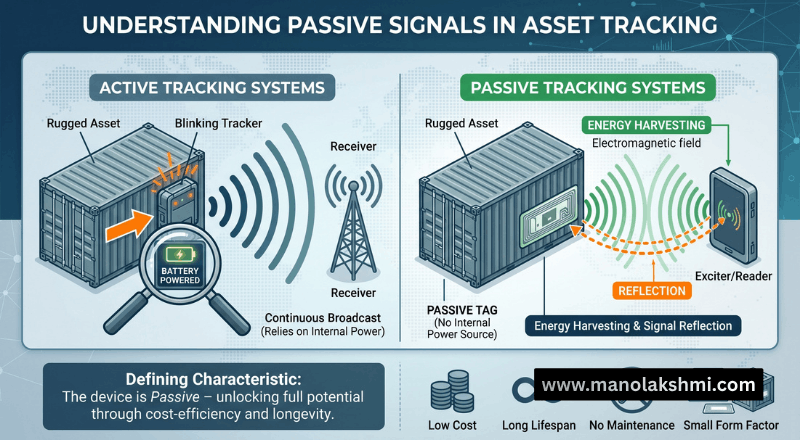
To truly appreciate the brilliance of passive signal technology, one must embrace the defining “passive” characteristic of the device, unlocking its full potential. Passive tracking systems use energy harvesting or reflection to broadcast signals, unlike active systems that rely on batteries.
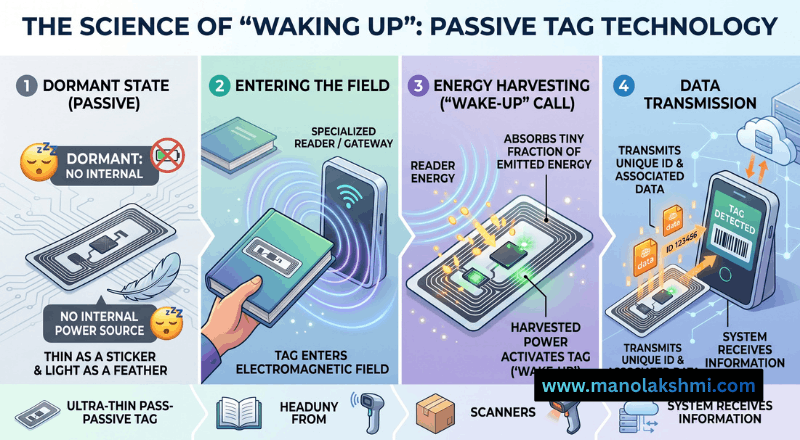
The Science of “Waking Up”
In a passive system, the tag or sensor lies dormant. It requires no internal power source, which means it can be as thin as a sticker and as light as a feather. When this tag enters the field of a specialised reader or gateway, it absorbs a tiny fraction of the energy emitted by that reader. This “wake-up” call provides just enough power for the tag to transmit its unique ID and any associated data back to the system.
Why “Passive” is the Growth Engine of Industrial IoT
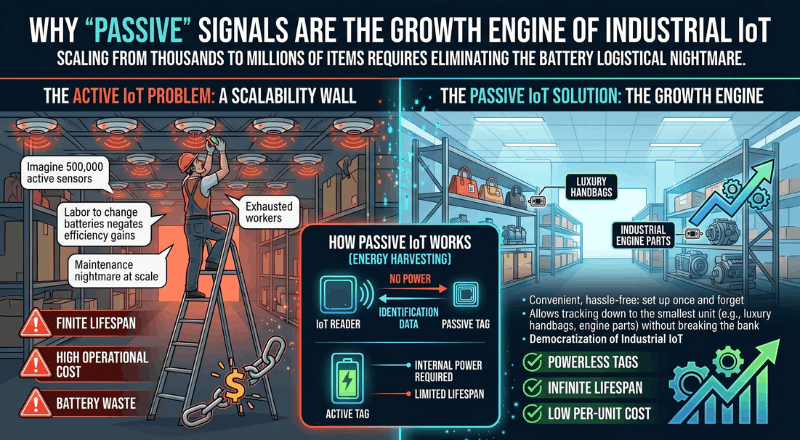
The shift toward passive signals is fuelled by the need to scale effectively. In a world where companies need to track millions of items—from individual luxury handbags to industrial engine parts—the cost and maintenance of batteries become a logistical nightmare. Imagine a warehouse with 500,000 active sensors; the labour required just to change batteries would negate any efficiency gained.
Passive signals solve this. They provide a convenient, hassle-free solution you can set up once and not worry about again. This shift represents the democratisation of industrial IoT, allowing companies to extend location tracking down to the smallest unit of inventory without breaking the bank.
Technologies Compared: RFID, Bluetooth, and UWB
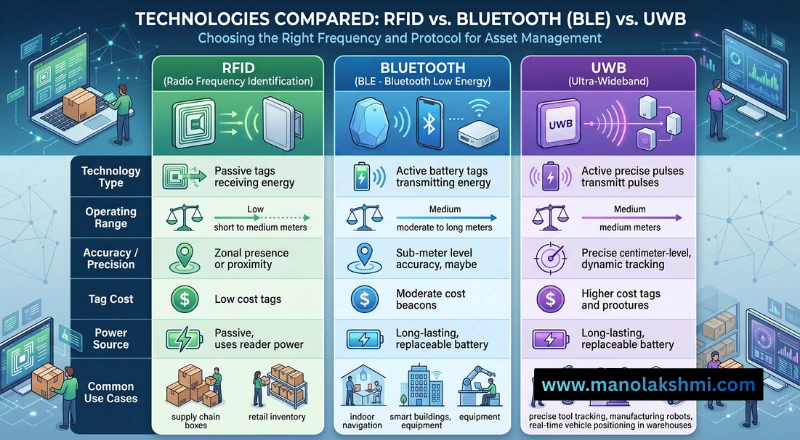
Choosing the right frequency and protocol is the cornerstone of a successful asset management strategy. While several technologies utilise passive or near-passive signals, three dominate the conversation: RFID, Bluetooth (BLE), and UWB.
RFID (Radio Frequency Identification)
RFID remains the titan of the passive world. Specifically, UHF (ultra-high frequency) RFID allows for the reading of hundreds of tags per second from several metres away without a direct line of sight.
- The Strength: Unrivalled cost-efficiency. Tags can be as cheap as just a few cents.
- The Use Case: High-volume inventory management, retail apparel, and closed-loop pallet tracking.
Bluetooth Low Energy (The Rise of Ambient IoT)
While traditionally “active”, the evolution of Bluetooth has led to “ambient IoT” or “passive BLE”. These tags harvest energy from surrounding radio waves (like Wi-Fi or cellular signals) to transmit data.
- The Strength: Compatibility with existing infrastructure. Almost every smartphone and modern laptop can act as a reader.
- The Use Case: Hospital equipment tracking and office asset management, where specialised RFID readers might be too intrusive.
UWB (Ultra-Wideband)
UWB is the gold standard for precision. While most UWB systems are active, new “passive” and semi-passive UWB configurations are emerging.
- The Strength: centimetre-level accuracy. UWB doesn’t just tell you an item is in the room; it tells you which shelf and which side of the shelf.
- The Use Case: High-tech manufacturing where the exact position of a tool or component is critical for automated assembly lines.
|
Features |
RFID (Passive) |
Bluetooth (Passive/Ambient) |
UWB (Precision) |
|
Cost per Tag |
Lowest ($) |
Moderate ($$) |
High ($$$) |
|
Accuracy |
Zone-level |
Room-level |
Centimeter-level |
|
Infrastructure |
Requires dedicated readers |
uses existing BLE devices |
Requires specialized anchors |
|
Best For |
Mass Inventory |
General Asset Visibility |
High-Precision RTLS |
Benefits of Passive Tracking for the Supply Chain
The transition to passive real-time location systems (RTLS) is not just a line-item upgrade; it is a strategic move that delivers compounding interest across the entire supply chain.
Drastic Reduction in Operational Costs
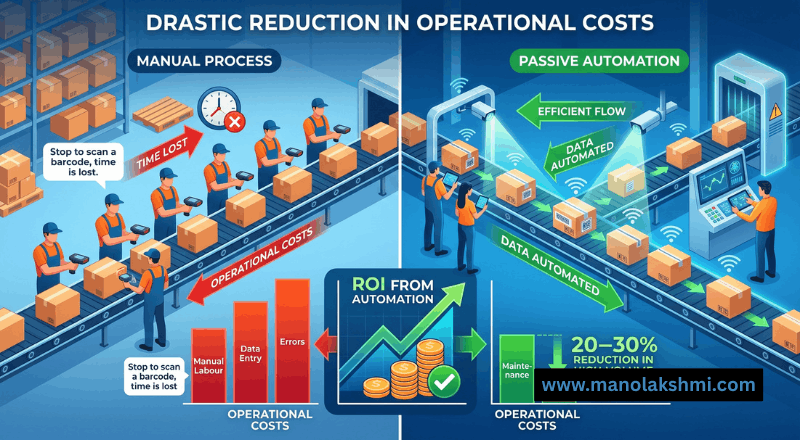
The most immediate benefit is the ROI found in the elimination of manual labour. Every time a worker has to stop to scan a barcode, time is lost. Passive signals automate this data capture. In large-scale logistics, removing the “human-in-the-loop” for data entry can reduce labour costs by 20–30% in high-volume environments.
Unprecedented Inventory Accuracy
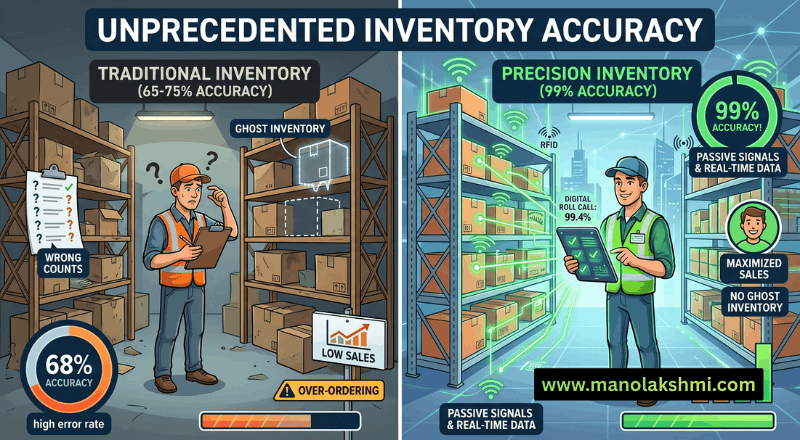
Most warehouses operate with an inventory accuracy of 65–75%. Passive signals can push that number toward 99%. By having a constant “digital roll call” of items, businesses can eliminate the “ghost inventory” that leads to missed sales or over-ordering.
Enhanced Sustainability -signals
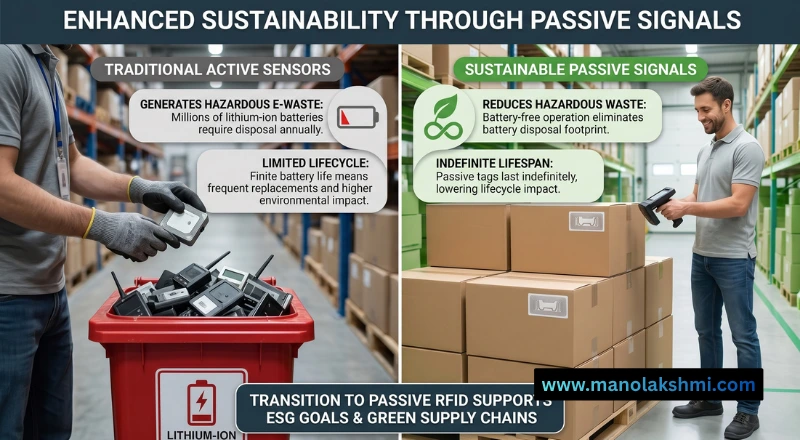
In an age where ESG (Environmental, Social, and Governance) goals are paramount, passive signals offer a green alternative. By eliminating millions of lithium-ion batteries from the supply chain, companies reduce their hazardous waste footprint. Furthermore, the longevity of passive tags—which can last indefinitely—means a lower lifecycle impact compared to active sensors.
Shrinkage and Loss Prevention
“Where did it go?” It’s the most costly question in logistics. Passive signals provide an audit trail. If a high-value asset leaves a designated zone without authorisation, the system triggers an immediate alert. This creates a “geofence” of security that protects the bottom line.
Implementing Passive RTLS: A Roadmap to Success
Moving from a manual system to a passive RTLS requires more than just buying tags. A clear understanding of how data flows within the organisation is essential.
-
Step 1: Define the “Granularity of Truth”
Do you need to know exactly which bin a bolt is in (UWB) or just that the pallet of bolts has entered the loading dock (RFID)? Defining the required level of precision prevents over-engineering and keeps costs low.
-
Step 2: Infrastructure Mapping
Passive signals have range limitations. Successful implementation involves mapping the “choke points” (entry/exit gates) and “coverage zones” (storage areas). For industrial IoT applications, this might mean installing overhead readers in a warehouse or integrating gateways into existing lighting fixtures.
-
Step 3: Data Integration and the “Digital Twin”
The signal is just hardware; the value is in the software. The data from passive tags must feed into your ERP (Enterprise Resource Planning) or WMS (Warehouse Management System). This creates a digital twin—a real-time virtual representation of your physical operations.
-
Step 4: Pilot and Pivot
Start with a high-impact, low-complexity area—perhaps tracking returnable transport items (RTIs) like crates or bins. Once the ROI is proven in a controlled environment, scaling to the rest of the supply chain becomes a data-driven decision rather than a leap of faith.
Real-World Success: From Vision to Value

-
Case Study 1: A Global Retail Giant
One of the world’s largest apparel retailers implemented passive RFID across its entire global footprint. By tagging every garment at the point of manufacture, they achieved 98% inventory accuracy. This allowed them to implement “Ship from Store” capabilities, turning every retail location into a mini-fulfilment centre. The result? A massive surge in e-commerce profitability and a significant reduction in markdowns.
-
Case Study 2: Aerospace Manufacturing
In the manufacturing of aircraft, losing a specialised tool can shut down a production line, costing thousands of dollars per minute. A major aerospace firm utilised a hybrid passive system to track thousands of tools. The system provided a real-time map of tool locations, reducing “search time” by 80% and ensuring that no tool was ever left inside an airframe—a critical safety requirement.
Future Trends & Challenges: The Road Ahead
As we look toward the horizon, the potential of passive signals only grows. However, the path is not without its hurdles.
The Rise of Energy Harvesting

The future of tracking technology lies in energy harvesting. We are seeing the development of tags that can draw power from ambient light, heat, or even the vibrations of a moving truck. This will extend the range and capability of passive signals far beyond their current limits.
AI and Predictive Analytics-signals

The massive influx of data from passive signal is a goldmine for artificial intelligence. Soon, systems won’t just tell you where an asset is; they will predict where it should be or where a bottleneck is likely to form, allowing managers to intervene before a crisis occurs.
Challenges: Interference and Standards -signals
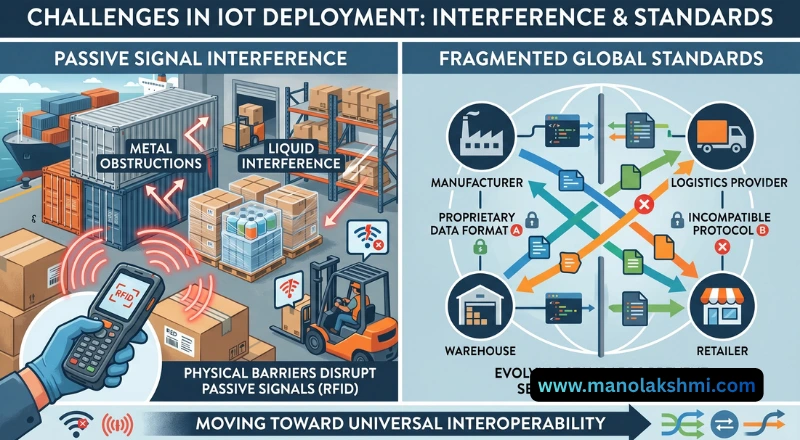
The “Wild West” of IoT protocols is slowly settling, but challenges remain. Metal and liquids can interfere with certain passive signals (like RFID). Furthermore, global standards for data sharing across different companies in a supply chain are still evolving. For passive signals to reach their full potential, the industry must move toward universal interoperability.
Conclusion: Embracing the Invisible

The story of the modern supply chain is a story of visibility. For too long, we have operated in the shadows, relying on guesswork, manual tallies, and the hope that what we need is where we think it is.
Passive signal change that narrative. They offer a way to give a voice to the voiceless objects in our world. They provide a cost-effective, scalable, and sustainable bridge between the physical and the digital. By embracing these technologies, logistics and supply chain professionals aren’t just tracking assets; they are orchestrating a more intelligent, responsive, and resilient world.
The future is calling. It’s a quiet, persistent signal—and it’s telling us that the age of total visibility is finally here. Are you listening?
Actionable Insights for Decision Makers:
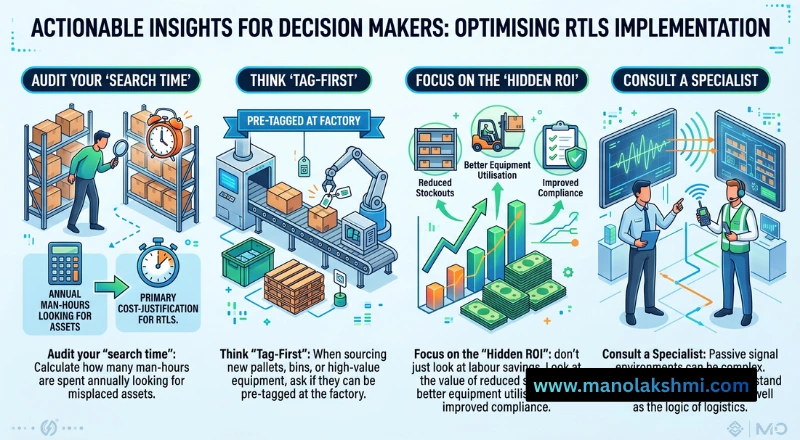
Audit your “search time”: Calculate how many man-hours are spent annually looking for misplaced assets. This is your primary cost-justification for RTLS.
Think “Tag-First”: When sourcing new pallets, bins, or high-value equipment, ask if they can be pre-tagged at the factory.
Focus on the “Hidden ROI”: don’t just look at labour savings. Look at the value of reduced stockouts, better equipment utilisation, and improved compliance.
Consult a Specialist: Passive signal environments can be complex. Partner with experts who understand the physics of radio waves as well as the logic of logistics.
The journey to 100% visibility begins with a single signal. Let it be a passive one.
click here please visit an support my post AC vs. DC: Amazing Key Differences in Electrical Current

Elevate your lifestyle with our curated content on technology, sports, travel, health, and fashion. Stay ahead of the trends and make informed choices.