Have you ever sat at your desk, perhaps during a slow moment at work or school, and tried a simple experiment with two pens? It seems like the easiest task in the world: hold one pen in each hand, stretch your arms out, and bring the tips together until they touch perfectly. With both eyes open, you likely succeed on the first try. But the moment you snap one eye shut, the task transforms into a frustrating game of “close but no cigar”. “You might find yourself stabbing at the air, with one pen tip passing inches in front of or behind the other.
This simple act of trying to touch the tips of two pens together reveals a fascinating aspect of how we perceive the world—our depth perception. It is a cornerstone of our daily existence, yet we rarely stop to think about the complex biological machinery that allows us to catch a ball, pour a cup of coffee without spilling, or navigate a crowded sidewalk.
In this exploration, we will dive deep into the science of sight. We will uncover why our brains prefer two viewpoints over one, how our eyes collaborate to build a three-dimensional map of our surroundings, and why the “pen touch test” is the ultimate demonstration of our visual prowess.
- Depth Perception Explained: Seeing the World in 3D
- Binocular vs. Monocular Vision: A Tale of Two Perspectives
- Visual Accuracy & the Pen Touch Test
- The Role of Eye Dominance
- Impact on Hand-Eye Coordination
- Spatial Awareness: Beyond the Pens
- Why This Matters: Appreciating Our Visual System
- Conclusion: The Gift of Perspective
Depth Perception Explained: Seeing the World in 3D
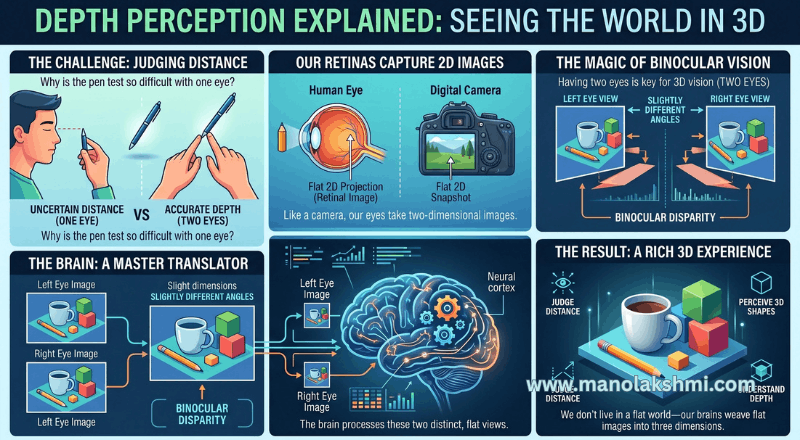
To understand why the pen test is so challenging with one eye, we first need to define what depth perception actually is. In the simplest terms, depth perception is the ability of the visual system to perceive the world in three dimensions (3D) and to judge the distance of an object.
The human eye is often compared to a camera, but this comparison is slightly misleading. A camera takes a two-dimensional (2D) snapshot of a scene. Our retinas—the light-sensitive layers at the back of our eyes—also capture 2D images. However, we don’t live in a flat, 2D world. Our brains are master translators; they take those two flat images and weave them into a single, rich, 3D experience.
“Depth perception is the essential guide of our physical lives, deftly coordinating every reach, step, and gaze with remarkable precision.”
There are several ways the brain calculates depth, often categorised into “cues”. Some of these cues can be perceived with just one eye (monocular cues). Such as seeing that a larger object is closer than a smaller one. But the most powerful tool in our visual toolkit requires both eyes working in tandem. This is where the magic of binocular vision begins.
Binocular vs. Monocular Vision: A Tale of Two Perspectives
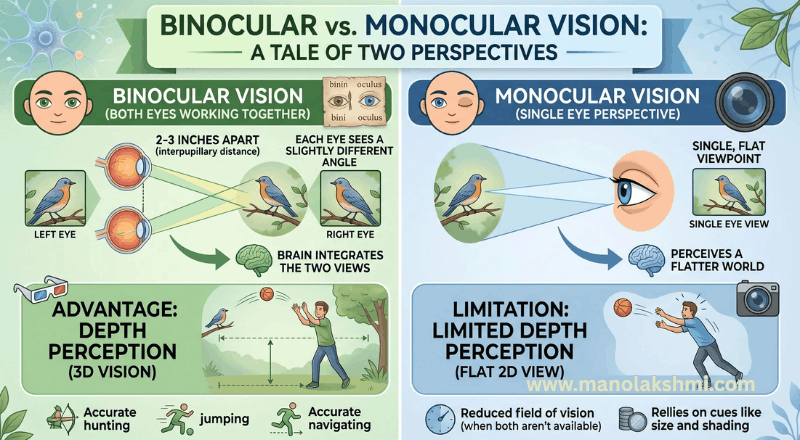
The term “binocular” comes from two Latin words: bini (double) and oculus (eye). Binocular vision is the capability to focus visually on an object using both eyes. Because our eyes are set about two to three inches apart, each eye sees the world from a slightly different angle.
The Power of Retinal Disparity
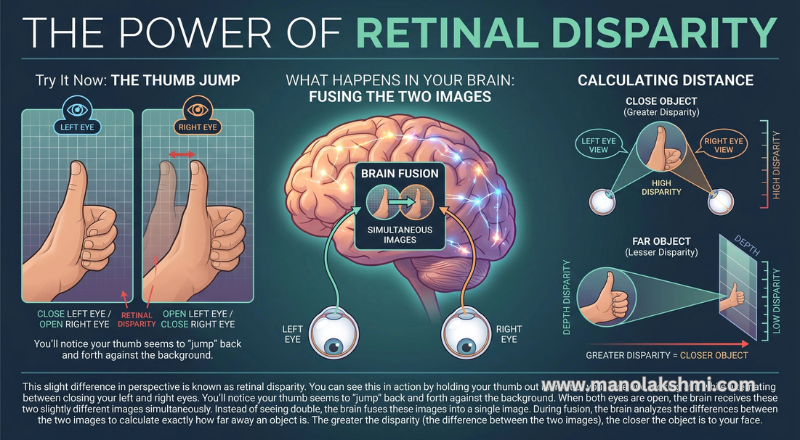
This slight difference in perspective is known as retinal disparity. You can see this in action by holding your thumb out in front of your face and looking at it while alternating between closing your left and right eyes. You’ll notice your thumb seems to “jump” back and forth against the background.
When both eyes are open, the brain receives these two slightly different images simultaneously. Instead of seeing double, the brain fuses these images into a single image. During fusion, the brain analyses the differences between the two images to calculate exactly how far away an object is. The greater the disparity (the difference between the two images), the closer the object is to your face.
Monocular Vision: The One-Eye Limitation
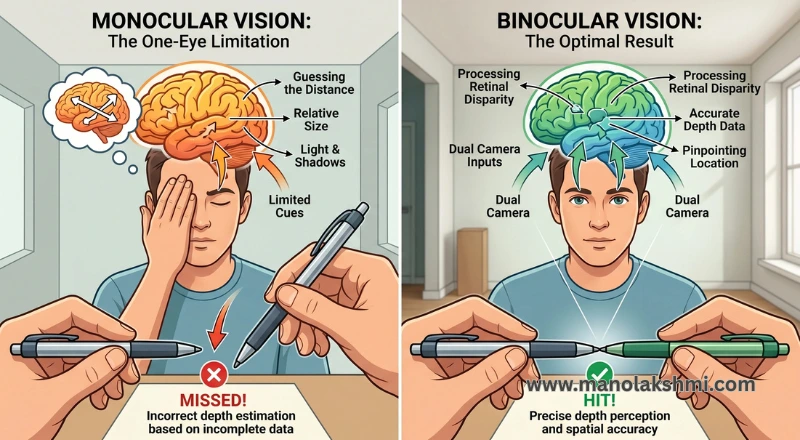
Monocular vision occurs when you use only one eye. While you aren’t suddenly “blind” to depth when you close an eye, your brain loses its most accurate data source. When you close one eye to perform the pen touch test, you are stripping your brain of retinal disparity. Suddenly, the brain has to rely on less precise cues, like the way light hits the pen or its relative size compared to the background.
Without that second “camera” providing a different angle, the brain struggles to pinpoint the exact location of the pen tips in space. This is why you often miss: your brain is essentially guessing the distance based on incomplete data.
Visual Accuracy & the Pen Touch Test
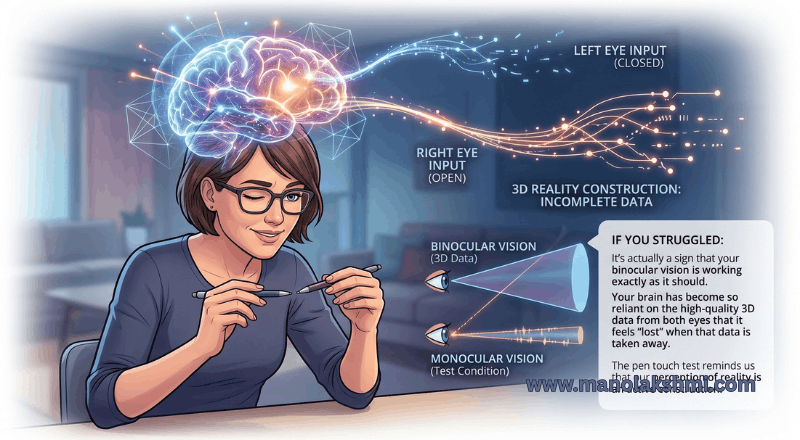
The pen touch test is more than just a fun trick; it is a direct measurement of your visual accuracy and spatial awareness. Let’s break down exactly what happens during this experiment.
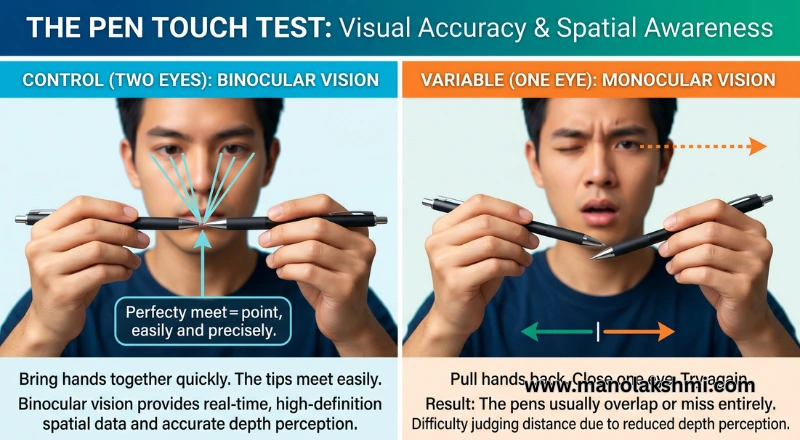
Step-by-Step: The Experiment
- The Control (Two Eyes): Hold a pen in each hand, arms extended. Bring your hands together quickly. Notice how easily the tips meet. This is your binocular vision providing real-time, high-definition spatial data.
- The Variable (One Eye): Pull your hands back. Close one eye. Now, try to bring the tips together again.
- The Result: Most people find that the pens either overlap or miss each other entirely.
Why Does This Happen?
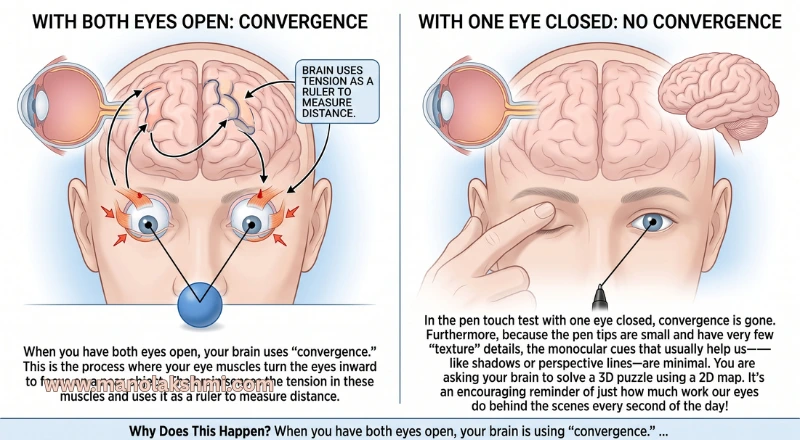
When you have both eyes open, your brain is using “convergence”. This is the process where your eye muscles turn the eyes inward to focus on a near object. The brain senses the tension in these muscles and uses it as a ruler to measure distance.
In the pen touch test with one eye closed, convergence is gone. Furthermore, because the pen tips are small and have very few “texture” details, the monocular cues that usually help us—like shadows or perspective lines—are minimal. You are asking your brain to solve a 3D puzzle using a 2D map. It’s an encouraging reminder of just how much work our eyes do behind the scenes every second of the day!
The Role of Eye Dominance
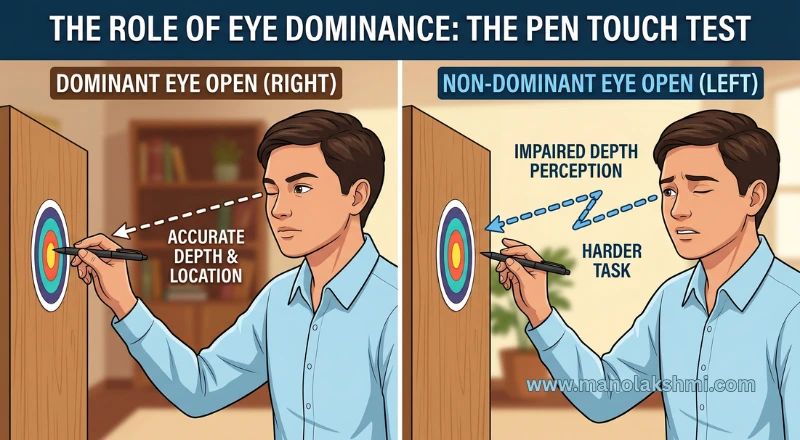
Not all eyes are created equal. Just as most people are right-handed or left-handed, almost everyone has a dominant eye. This is the eye that provides a slightly higher degree of input to the visual cortex of the brain and more accurately relays information about the location of objects.
In the pen touch test, you might notice that the task is significantly harder when you close your dominant eye compared to when you close your non-dominant eye.
How to Find Your Dominant Eye
If you want to see how eye dominance affects your spatial awareness, try this:
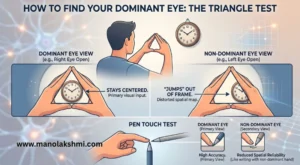
- Form a small triangle with your hands at arm’s length.
- Frame a small object on a distant wall (like a clock or a picture frame) inside that triangle.
- Close your left eye. If the object stays centred, your right eye is dominant.
- Close your right eye. If the object “jumps” out of the frame, your right eye is indeed the boss.
When you perform the pen touch test using only your non-dominant eye, your “spatial map” is even less reliable. The brain is used to relying on the dominant eye for the “primary” view. Switching to the secondary eye is like trying to write with your non-dominant hand—it can be done, but it lacks the fine-tuned accuracy we take for granted.
Impact on Hand-Eye Coordination
Hand-eye coordination is the ability to use visual information to guide and direct our hands in completing a task. The pen touch test is a pure distillation of this relationship.
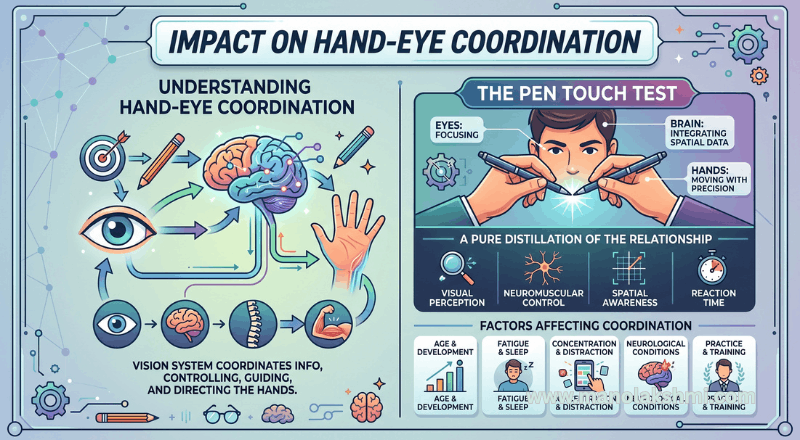
The Feedback Loop
Our movements aren’t just “fired and forgotten”. They exist in a constant feedback loop:
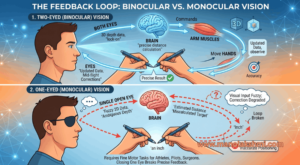
- The eyes see the position of the pens.
- The brain processes the distance and sends signals to the arm muscles.
- The hands move the pens.
- The eyes observe the movement and send updated data to the brain to make “mid-flight” corrections.
When you close one eye, the “Data” step in this loop becomes fuzzy. Your brain might tell your hand to move forward five inches, but because the visual input is 2D, the hand might actually need to move four and a half inches. Without the 3D “lock-on” provided by binocular vision, the feedback loop is broken.
“True coordination is a symphony played by the eyes and hands, conducted by a brain that sees the world in depth.”
This is why athletes, pilots, and surgeons require excellent binocular vision. Imagine trying to catch a baseball or thread a needle with one eye closed. While humans are remarkably adaptable and can learn to compensate over time, the initial loss of binocularity significantly degrades our ability to perform fine motor tasks accurately.
Spatial Awareness: Beyond the Pens
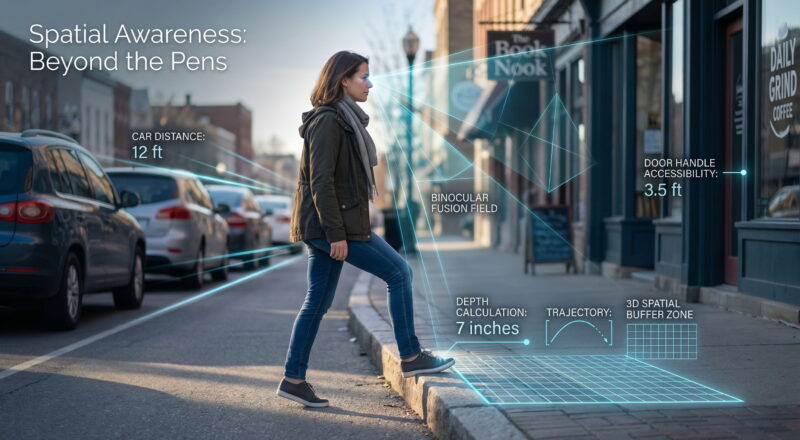
The struggle of the pen touch test highlights a broader concept: spatial awareness. This is our consciousness of the things around us and our body’s position in relation to them.
Spatial awareness isn’t just about seeing; it’s about understanding volume, distance, and trajectory. Our binocular vision gives us a “buffer zone”. It allows us to know exactly how much space we have when parking a car or how high to lift our foot to clear a kerb.
When we lose that 3D perspective, our world shrinks. We become more cautious. We might reach for a door handle and grasp thin air. This is a common experience for individuals who have vision in only one eye. Over time, the brain learns “tricks” to compensate—such as moving the head from side to side to create motion parallax (the way near objects move faster across our field of vision than distant ones). However, the effortless, instant calculation provided by two eyes is a biological masterpiece that is hard to replicate.
Why This Matters: Appreciating Our Visual System
We often overlook how much we rely on our eyesight. We open our eyes in the morning, and the world simply is. But the pen touch test reminds us that our perception of reality is an active construction.
If you struggled with the test, don’t be discouraged! It’s actually a sign that your binocular vision is working exactly as it should. Your brain has become so reliant on the high-quality 3D data from both eyes that it feels “lost” when that data is taken away.
Practical Takeaways from the Pen Test
- Safety First: Understanding the limits of monocular vision is why we are told to be extra careful when driving with an eye patch or when one eye is dilated at the eye doctor’s.
- Athletic Training: Many athletes practise drills to improve their depth perception and eye tracking, recognising that visual accuracy is the bridge between talent and performance.
- Empathy for Others: This test gives us a small window into the lives of those with visual impairments, helping us appreciate the extra effort the brain must exert to navigate a world designed for two-eyed vision.
Conclusion: The Gift of Perspective
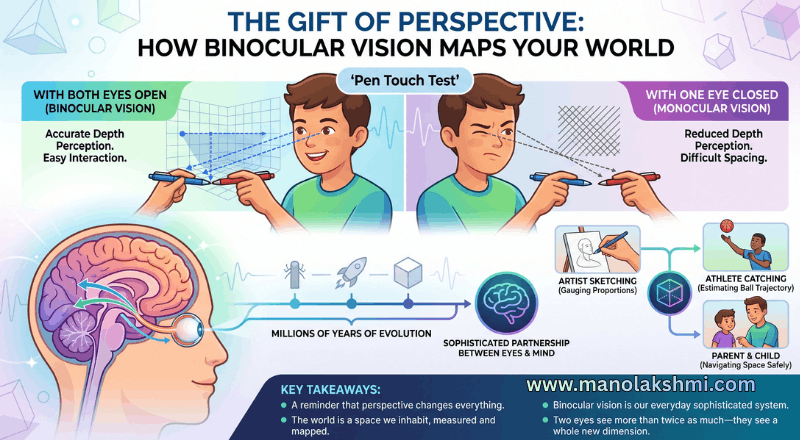
The next time you’re holding two pens, take a moment to marvel at your own brain. The fact that you can touch those tips together with both eyes open is the result of millions of years of evolution. It is a testament to the partnership between your eyes and your mind—a partnership that allows you to interact with a complex, three-dimensional universe with ease and grace.
The pen touch test is a simple reminder that our perspective changes everything. By closing one eye, we realise that the world isn’t just something we look at; it’s a space we inhabit, measured and mapped by the incredible power of binocular vision. So, give yourself a pat on the back (after making sure you can see where your back is!) for having such a sophisticated system working for you every single day.
Whether you’re an artist, an athlete, or just someone trying to hold a pen, remember: two eyes see more than just twice as much—they see a whole new dimension.

Elevate your lifestyle with our curated content on technology, sports, travel, health, and fashion. Stay ahead of the trends and make informed choices.