Prime Numbers: Why They Are Crucial in Number Theory
Prime numbers, those integers greater than 1 that are divisible only by 1 and themselves, occupy a foundational position within the realm of number theory. Their importance goes well beyond mere curiosities; they shape the structure of integers, inspire deep conjectures, and fuel the modern digital world.
Prime Numbers: Building Blocks of Integers
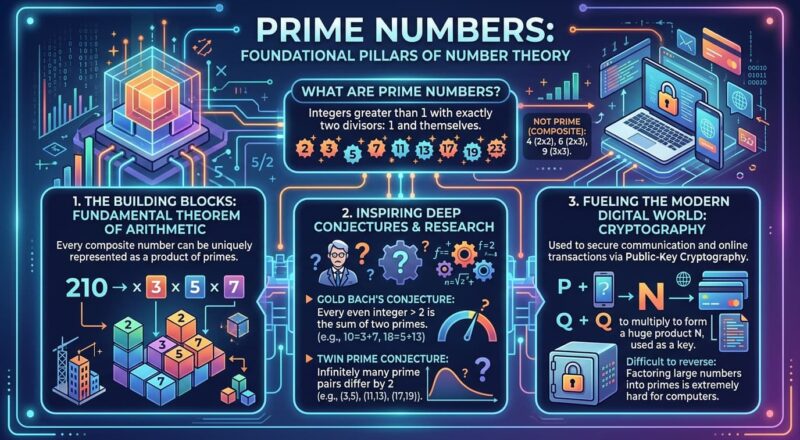
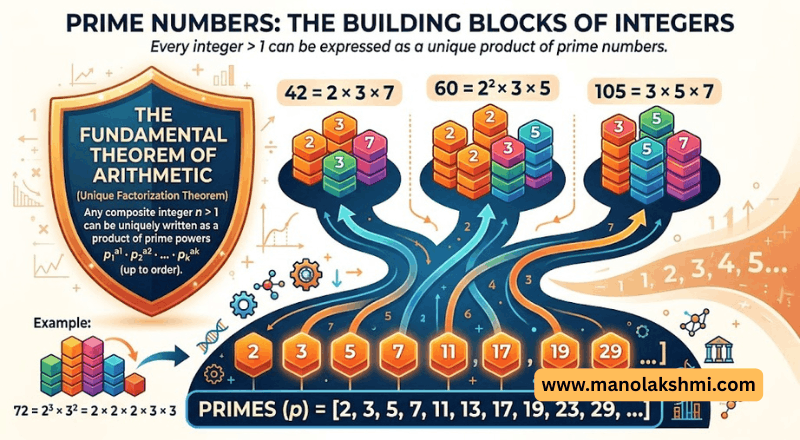
The most elementary way to understand why primes matter is to view them as the building blocks of all whole numbers. Every integer greater than 1 can be expressed as a product of prime numbers, and—thanks to the Fundamental Theorem of Arithmetic—this factorisation is unique up to the order of the factors.
“If the integers were a city, the primes would be its bricks; without them, nothing could be built.” – Anonymous mathematician.
This brick-and-mortar analogy captures the essence of a prime’s role. Just as every wall, arch, or tower is ultimately assembled from the same set of bricks, every composite number is assembled from the same set of primes. The uniqueness of that assembly guarantees that the arithmetic landscape is orderly rather than chaotic.
Why uniqueness matters
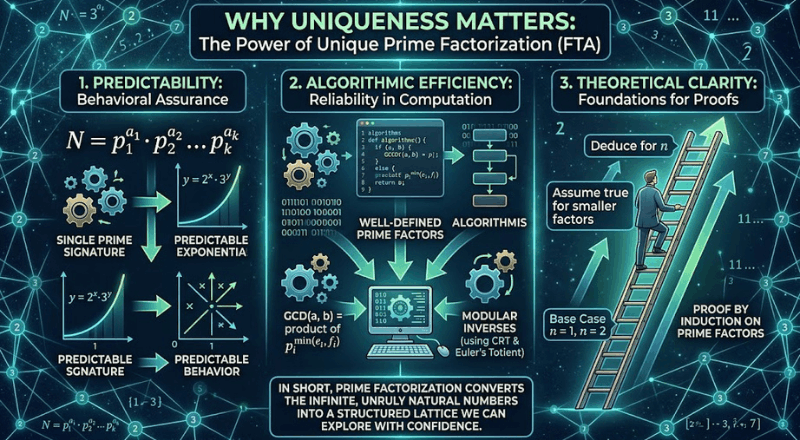
- Predictability – Because each integer has a single prime signature, mathematicians can predict how numbers will behave under multiplication, division, and exponentiation.
- Algorithmic efficiency – Many algorithms – ranging from greatest common divisor computations to modular inverses – rely on the fact that prime factors are well-defined.
- Theoretical clarity – Proofs that work “by induction on prime factors” (e.g., many results about divisibility) become possible only because each integer’s prime decomposition is unambiguous.
In short, the prime factorisation property converts the infinite, seemingly unruly set of natural numbers into a structured lattice that we can explore with confidence.
Prime Factorization & the Fundamental Theorem
The statement, in plain language,
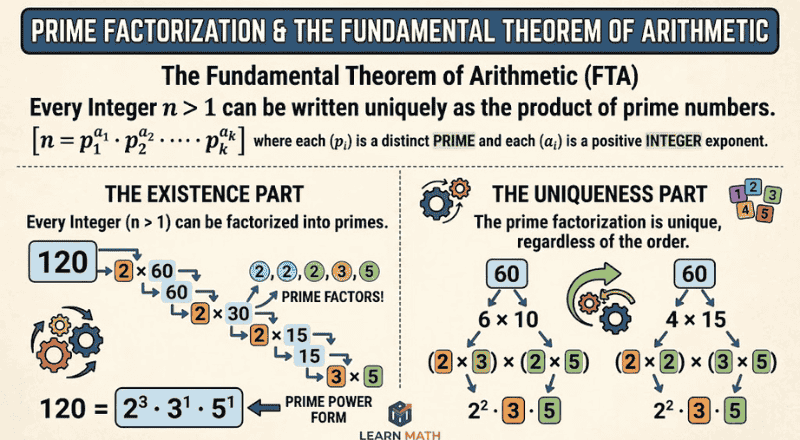
The Fundamental Theorem of Arithmetic (FTA) says the following: Every integer (n > 1) can be written uniquely as
[n = p_1^{a_1}, p_2^{a_2}, \dots, p_k^{a_k}]
where each (p_i) is a prime, and each exponent (a_i) is a positive integer.
The theorem has two parts: existence (every number can be broken down) and uniqueness (the breakdown is the only one, aside from order).
How the theorem underpins number‑theoretic results
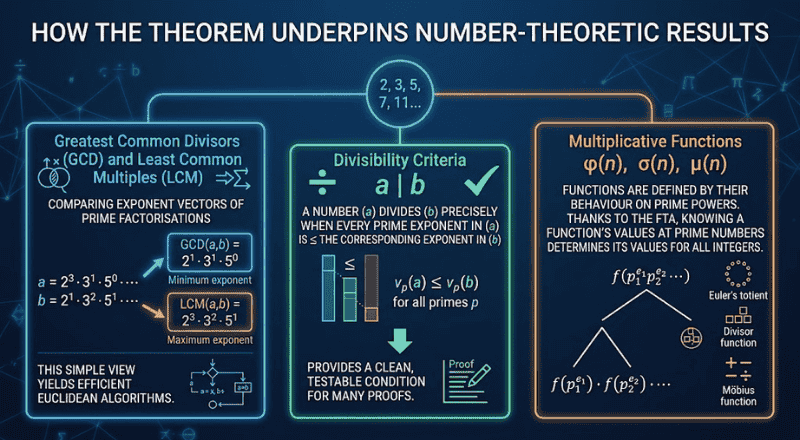
- Greatest Common Divisors (GCD) and Least Common Multiples (LCM) – By comparing the exponent vectors of the prime factorisations of two numbers, the GCD becomes the minimum exponent and the LCM the maximum. This simple view yields efficient Euclidean algorithms.
- Divisibility Criteria – A number (a) divides (b) precisely when every prime exponent in (a) is less than or equal to the corresponding exponent in (b). This provides a clean, testable condition for many proofs.
- Multiplicative Functions – Functions such as Euler’s totient (\varphi(n)), the divisor function (\sigma(n)), and the Möbius function (\mu(n)) are defined by their behaviour on prime powers. Thanks to the FTA, knowing a function’s values at prime numbers determines its values for all integers.
An accessible illustration
Consider the integer 360. Its prime factorisation is
[360 = 2^{3} \cdot 3^{2} \cdot 5^{1}.]
Any divisor of 360 must pick a power of 2 between 2^{0} and 2^{3}, a power of 3 between 3^{0} and 3^{2}, and a power of 5 between 5^{0} and 5^{1}. This simple “choose your exponents” rule stems directly from the FTA and makes counting divisors a matter of elementary combinatorics.
Why the FTA is a cornerstone
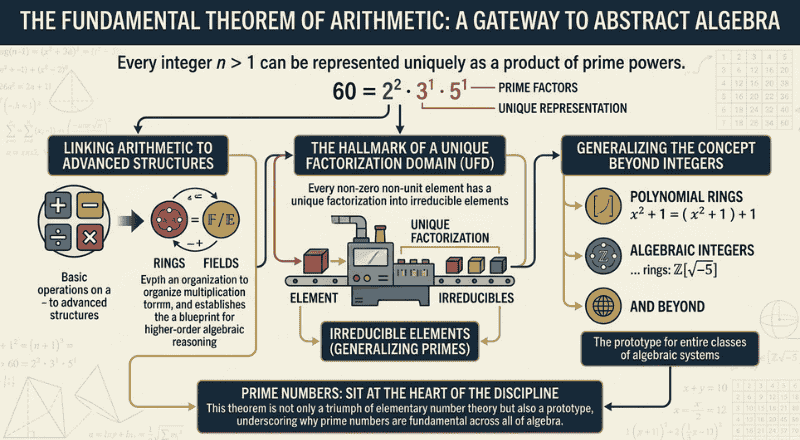
The theorem organises multiplication and links elementary arithmetic to advanced algebraic structures like rings and fields. In abstract algebra, the statement “every element factors uniquely into irreducibles” is the hallmark of a Unique Factorisation Domain (UFD). This concept generalises the prime‑factor world of the integers to polynomial rings, algebraic integers, and beyond.
Thus, the Fundamental Theorem of Arithmetic is not only a triumph of elementary number theory—it is a prototype for an entire class of algebraic systems, underscoring why prime numbers sit at the heart of the discipline.
Euclid’s Proof of Infinite Primes
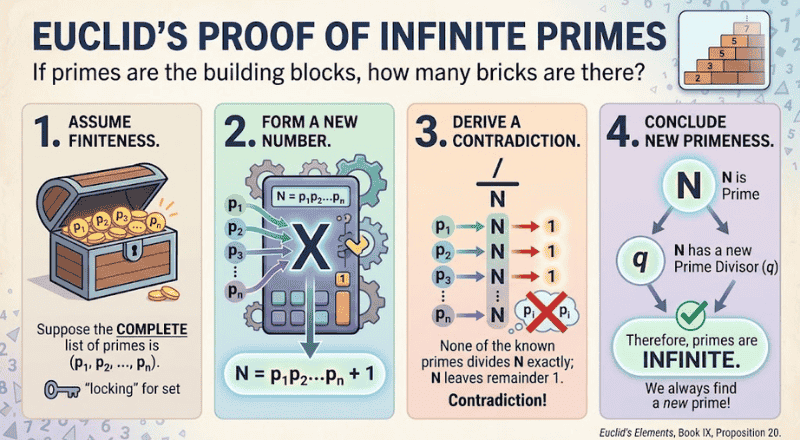
If primes are the building blocks, a natural question arises: How many bricks are there?
Around 300 BC, Euclid delivered a definitive proof that has stood the test of time: there are infinitely many prime numbers. The argument is astonishingly simple yet profound, and it serves as a template for many modern proofs of infinitude in mathematics.
Euclid’s classic construction
1. Assume finiteness. Suppose the list of all primes is (p_1, p_2, \dots, p_n).
2. Form a new number. Consider
[N = p_1p_2\cdots p_n + 1.]
3. Derive a contradiction. Every prime (pᵢ) divides the product (p₁p₂\cdots pₙ) exactly, so it leaves a remainder of 1 when dividing (N). Hence, none of the known primes divides (N).
4. Conclude new primeness. Either N itself is prime or it has a prime divisor not in the original list—in both cases, it contradicts the assumption that we listed all the primes.
Therefore, primes cannot be exhausted; there must be infinitely many.
Why Euclid’s proof matters
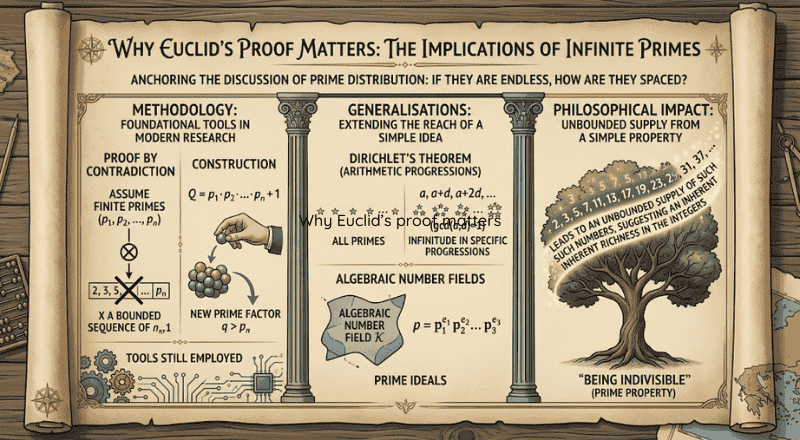
Methodology – It exemplifies proof by contradiction and construction, tools still employed in modern research.
Generalisations – Variations of Euclid’s idea prove infinitude in specific arithmetic progressions (Dirichlet’s theorem) and for prime ideals in algebraic number fields.
Philosophical impact – The proof shows that the simple property “being indivisible” leads to an unbounded supply of such numbers, suggesting an inherent richness in the integers.
Euclid’s theorem, therefore, anchors the discussion of prime distribution: if they are endless, how are they spaced? That question guides the next set of topics.
Prime Distribution & the Riemann Hypothesis
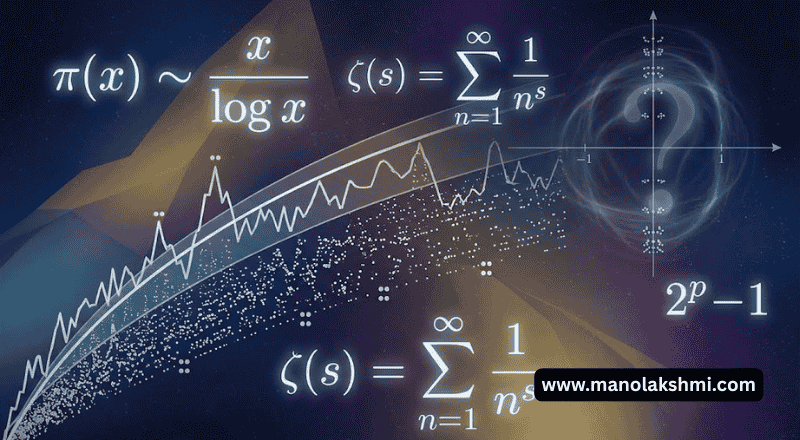
Even though there are infinitely many primes, they do not appear at regular intervals. The distribution of primes is a central, still partially mysterious, subject of number theory.
The Prime Number Theorem (PNT) – a first approximation
The Prime Number Theorem tells us that the number of primes less than a large number (x) (denoted by \pi(x)) is approximated by
[ \pi(x) \sim \frac{x}{\log x}, ]
where (\log) denotes the natural logarithm. This result, proved independently by Hadamard and de la Vallée-Poussin in 1896, reveals a striking fact: primes become sparser but in a precisely quantifiable way.
Beyond the average: fluctuations
The PNT gives an average density, but the actual gaps between consecutive primes can be surprisingly small (twin primes) or surprisingly large (prime gaps of length comparable to (\log^2 x)). Understanding these fluctuations is the heart of many current research programmes.
Enter the Riemann Hypothesis
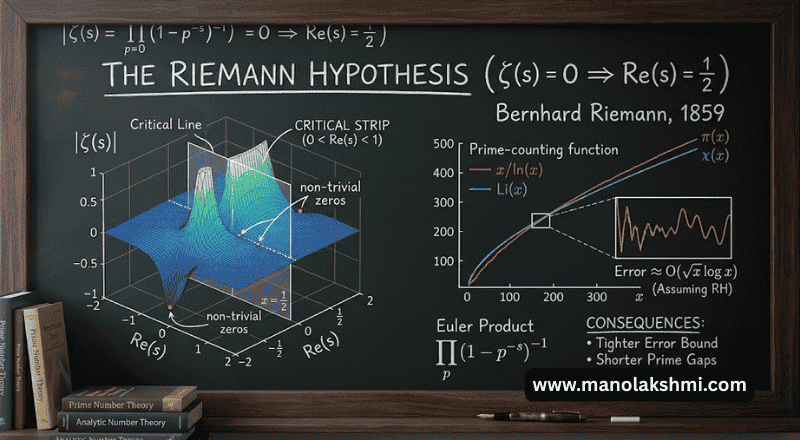
At the core of prime-distribution research lies the Riemann Hypothesis (RH), formulated by Bernhard Riemann in 1859. The hypothesis asserts that all non‑trivial zeros of the Riemann zeta function (\zeta(s)) have a real part of (1/2). Though the statement belongs to complex analysis, its consequences are purely arithmetic:
- Error term control. RH implies a much tighter bound on the difference between (\pi(x)) and (\frac{x}{\log x}). The error term would be on the order of (\sqrt{x}\log x) rather than the larger bounds currently known unconditionally.
- Prime gaps. Under RH, the gap between consecutive primes (p_{n+1} – p_n) is (O(\sqrt{p_n}\log p_n)), a dramatic improvement over the best unconditional results.
- Distribution of primes in short intervals. RH predicts that even in intervals as short as (x^{1/2+\epsilon}), there will be primes for sufficiently large x.
Because the Riemann zeta function encodes prime information through its Euler product
[ \zeta(s)=\prod_{p\ \text{prime}} \frac{1}{1-p^{-s}}, ]
The zeros of (\zeta(s)) indirectly dictate how primes are arranged. This deep connection—linking complex analysis, algebra, and arithmetic—exemplifies why prime numbers are a bridge between distinct branches of mathematics.
Why the hypothesis captivates mathematicians
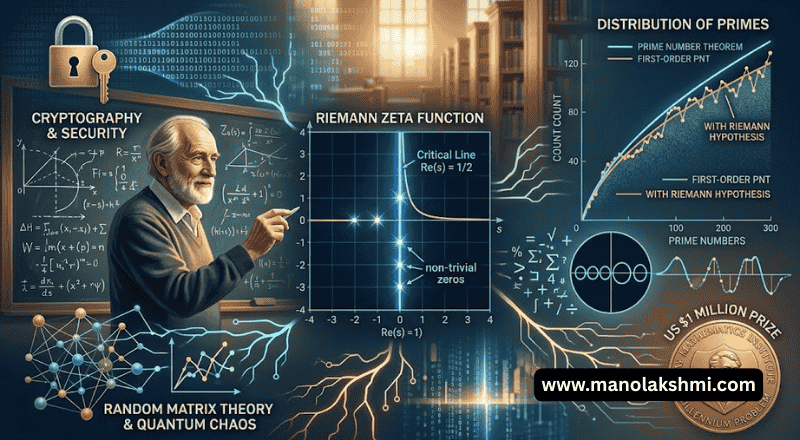
- Unresolved millennium problem. RH is one of the Clay Mathematics Institute’s seven Millennium Prize Problems, with a US $1 million reward for a proof or counterexample.
- Widespread implications. A proof would instantly sharpen estimates in countless theorems across number theory, cryptography, and even random matrix theory.
- Elegant symmetry. The conjecture’s simplicity—“All non‑trivial zeros lie on a line”—contrasts with the complex terrain needed to approach it, making it a tantalising puzzle.
Thus, while the Prime Number Theorem gives a first-order picture, the Riemann Hypothesis endeavours to capture the fine-grained texture of prime distribution, reinforcing just how pivotal primes are to the deeper architecture of mathematics.
Primes in Cryptography & Modern Applications

If prime numbers are already central to pure mathematics, why do they appear on the front page of technology news? The answer lies in the hardness of certain problems built on prime factorisation.
RSA encryption – the classic example
The RSA algorithm, invented by Rivest, Shamir, and Adleman in 1977, hinges on three steps:
- Key generation – Choose two large, random primes (p) and (q) (each hundreds of digits long). Compute (n = pq) and (\phi(n) = (p-1)(q-1)).
- Public key – Publish ((e, n)), where (e) is a small integer coprime to (\phi(n)).
- Private key – Keep (d) such that (ed \equiv 1 \pmod{\phi(n)}).
Encrypting a message (M) (converted to a number) uses the public key.
[C \equiv M^{e} \pmod{n}.]
Decrypting uses the private key:
[M \equiv C^{d} \pmod{n}.]
The security rests on the difficulty of factoring the large composite number (n) back into its constituent primes (p) and (q). Despite decades of effort, no polynomial‑time algorithm (classical or quantum, apart from Shor’s algorithm) can reliably factor such numbers when they are sufficiently large.
Elliptic curve cryptography (ECC) – primes in a new guise
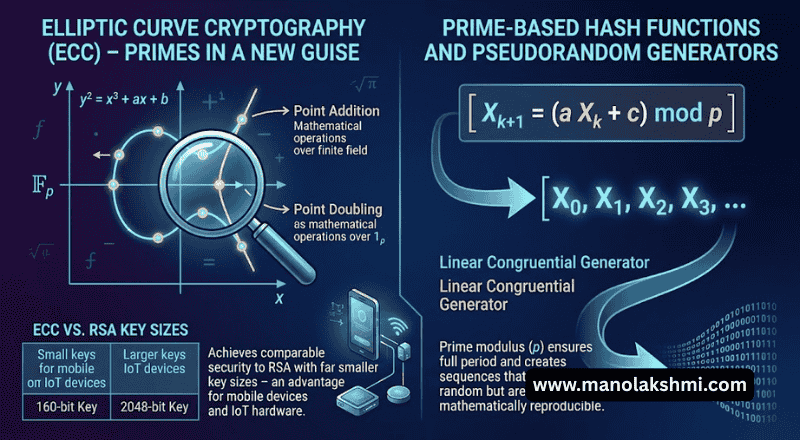
ECC employs the algebraic structure of elliptic curves over finite fields (\mathbb{F}_p), where p is a prime (or a power of a prime). The choice of a prime modulus ensures a well‑behaved field, enabling efficient and secure operations such as point addition. ECC achieves comparable security to RSA with far smaller key sizes—an advantage for mobile devices and IoT hardware.
Prime‑based hash functions and pseudorandom generators
Many cryptographic hash functions and deterministic random bit generators rely on prime modulus arithmetic to produce sequences that appear random but are mathematically reproducible. For example, the classic linear congruential generator uses
[ X_{k+1} = (a X_k + c) \bmod p, ]
where a prime modulus (p) helps achieve a full period when the parameters are chosen correctly.
Why primes dominate the digital world

- Factorisation hardness – The problem of splitting a large integer into its prime components is computationally intensive, providing a “one‑way function” essential for public‑key systems.
- Modular arithmetic properties – Primes guarantee that every non‑zero element has a multiplicative inverse modulo p; this field property (a consequence of Euclid’s lemma) is crucial for algorithms like Diffie‑Hellman key exchange.
- Mathematical guarantees – Many security proofs assume the existence of a large prime with specific properties (e.g., a safe prime where ((p-1)/2) is also prime) to thwart certain attacks.
While quantum computers threaten the RSA and ECC paradigms through Shor’s algorithm, the prime‑centric mindset continues to influence post‑quantum proposals, such as lattice‑based cryptography, where prime‑indexed structures still arise in key generation and error‑correcting codes.
The Takeaway: Why Prime Numbers Matter
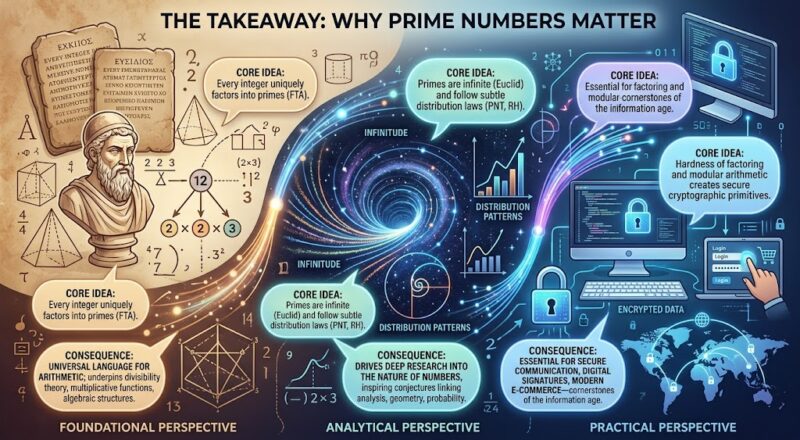
From the ancient stone tablets of Euclid to the silicon chips that power today’s internet, prime numbers have persisted as a guiding thread that unites disparate realms of thought. Their importance can be summarised in three interlocking perspectives:
|
Perspective |
Core Idea |
Consequence |
| Foundational: | Every integer uniquely factors into primes (FTA). | Provides a universal language for arithmetic; underpins divisibility theory, multiplicative functions, and algebraic structures. |
| Analytical: | Primes are infinite (Euclid) and follow subtle distribution laws (PNT, RH). | Drives deep research into the nature of numbers, inspiring conjectures that link analysis, geometry, and probability. |
| Practical: | The hardness of factoring and modular arithmetic creates secure cryptographic primitives. | It is essential for secure communication, digital signatures, and modern e-commerce—cornerstones of the information age. |
A quote to close
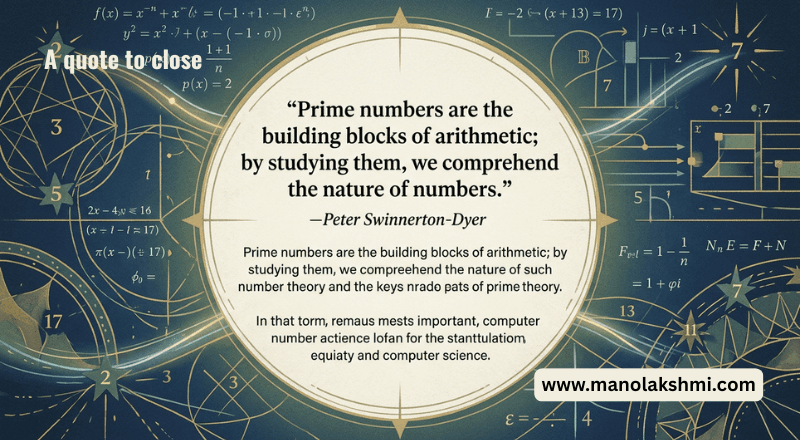
“Prime numbers are the building blocks of arithmetic; by studying them, we comprehend the nature of numbers.” – Peter Swinnerton‑Dyer
In the grand tapestry of mathematics, primes are the immutable constants that both simplify and complicate the story of numbers. Their simplicity (a number with no proper divisors) belies a richness that fuels centuries of research and powers the technologies we rely on daily.
Whether a reader is fascinated by the elegance of Euclid’s proof, intrigued by the mystery of the Riemann Hypothesis, or concerned about the security of online banking, prime numbers are the common denominator—the reason algebra, analysis, and computer science converge on a single, timeless concept.
Further Reading

- The Music of the Primes by Marcus du Sautoy – an accessible narrative of the quest to understand prime distribution.
- “A Classical Introduction to Modern Number Theory” by Ireland and Rosen links basic concepts with advanced topics like the Riemann zeta function.
- “An Introduction to Mathematical Cryptography” by Hoffstein, Pipher, and Silverman explores the role of prime numbers in public-key systems.
By appreciating why primes are crucial—building blocks, unique factorisers, infinite explorers, distribution enigmas, and cryptographic guardians—anyone can glimpse the profound harmony that runs through the seemingly chaotic world of numbers. The journey from the simplest definition of a prime to the frontiers of research reminds us that the deepest insights often arise from the most elementary ideas.
Click here: The Fibonacci Sequence: Uncovering Its Significance

Elevate your lifestyle with our curated content on technology, sports, travel, health, and fashion. Stay ahead of the trends and make informed choices.