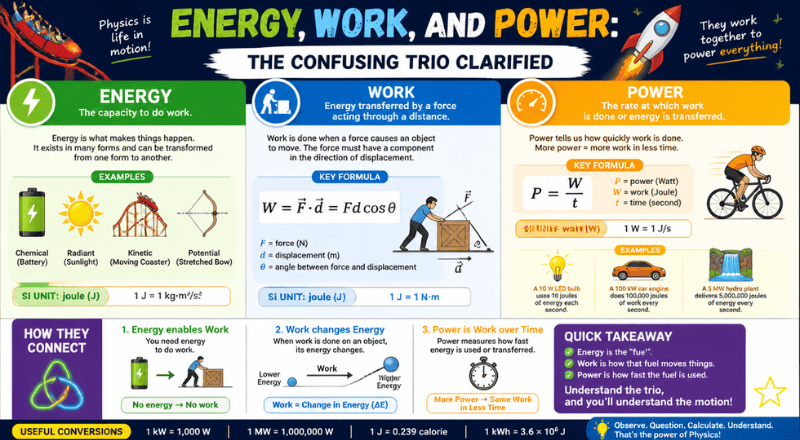
- Energy, Work, and Power: The Confusing Trio Clarified
- Defining Energy and Its Forms
- Understanding Mechanical Work
- The Role of Power in Physics
- Key Differences Between the Trio
- How to Calculate Energy, Work, and Power
- Practical Examples of Energy Transformation
- Why These Concepts Matter in Physics
- Conclusion
Energy, Work, and Power: The Confusing Trio Clarified
In the world of physics, few terms are as frequently used—and as frequently misused—as “energy”, “work”, and “power”. While they are often used interchangeably in casual conversation, these three concepts represent distinct, fundamental pillars of physical science. Understanding their precise definitions and the mathematical relationships that connect them is essential for anyone delving into physics basics.
Whether you are a student preparing for an exam or an enthusiast eager to master physics concepts explained clearly, this guide will serve as your roadmap. By the end of this exploration, you will understand how these quantities interact, how to distinguish them, and why they serve as the foundation for our technological world.
Defining Energy and Its Forms
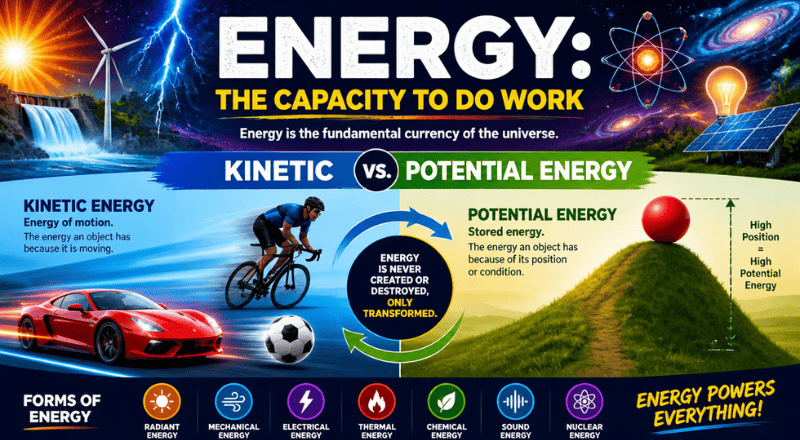
Energy is the fundamental currency of the universe. In physics, energy is simply the ability to get work done. Without energy, motion, change, and interaction, they would essentially cease to exist. Because energy cannot be created (or) destroyed—a principle known as the Law of Conservation of Energy—it is constantly shifting between different states.
The Two Pillars: Kinetic and Potential Energy
To understand energy transformation, one must first distinguish between the two primary forms of mechanical energy:
Kinetic Energy: This is the energy an object possesses due to its motion. Any object with mass that is moving has kinetic energy. The quicker an entity moves, or the more mass it carries, the more kinetic energy it has.
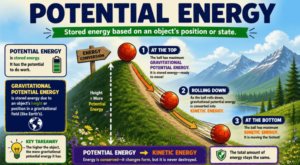
Potential Energy: This is the energy stored in an object due to its position or condition. The most common form is gravitational potential energy. Which refers to the energy an object gains when lifted against the force of gravity. A ball perched at the top of a hill has high potential energy. As it rolls down, that potential energy is converted into kinetic energy.
Energy is measured in Joules (J), a standard scientific unit that applies to all its various forms, including thermal, chemical, nuclear, and electromagnetic energy.
Understanding Mechanical Work
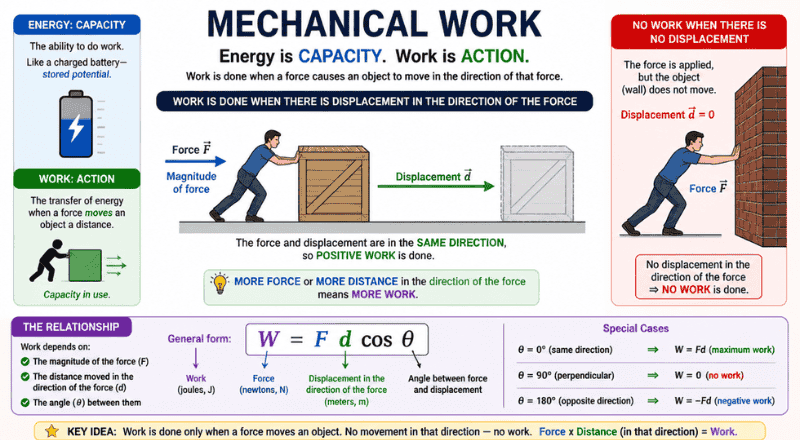
If energy is the “capacity”, then mechanical work is the “action”. Work is performed when a force is applied to an object, causing that object to undergo a displacement.
A common misconception is that simply pushing against a brick wall constitutes work. However, in physics, if an object does not move, no work is done. Work depends strictly on two things: the magnitude of the force applied and the distance the object travels in the direction of that force.
The Nuance of Direction
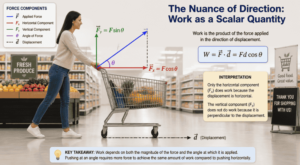
Work is a scalar quantity, meaning it has magnitude but no specific direction. However, it is highly sensitive to the angle of the force. If you push a shopping cart forward, you are doing work. If you push downward on the handle while the cart moves forward, only the horizontal component of your force contributes to the work done. No work is performed by a force when it acts perpendicularly to the direction of motion, as seen when gravity acts upon a person walking along a horizontal path.
The Role of Power in Physics
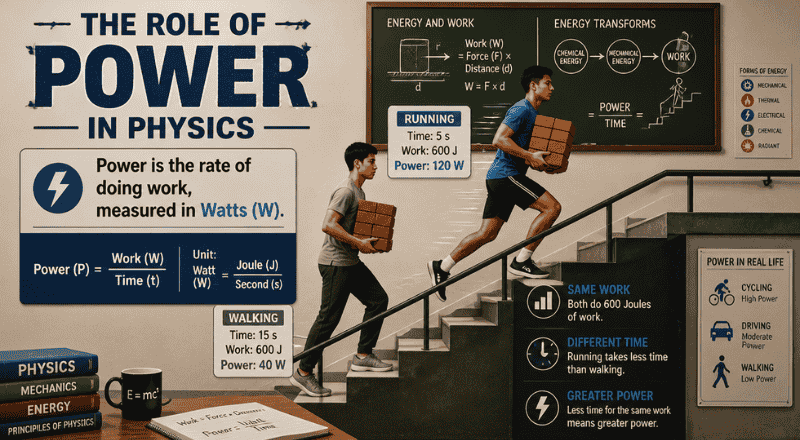
If work is the amount of effort put in, power is all about how quickly that effort occurs. It answers the question, “How fast was the work completed?”
Two people might carry the same load of bricks up a flight of stairs. Both individuals perform the same amount of mechanical work because the displacement and the gravitational force are identical. However, the person who runs up the stairs performs the task in less time, meaning they exert more power.
Power is measured in Watts (W). One watt is equivalent to one joule of work performed per second. This relationship is critical in engineering, biology, and machine design, as it distinguishes between the total exertion required for a task and the intensity required to complete it rapidly.
Key Differences Between the Trio
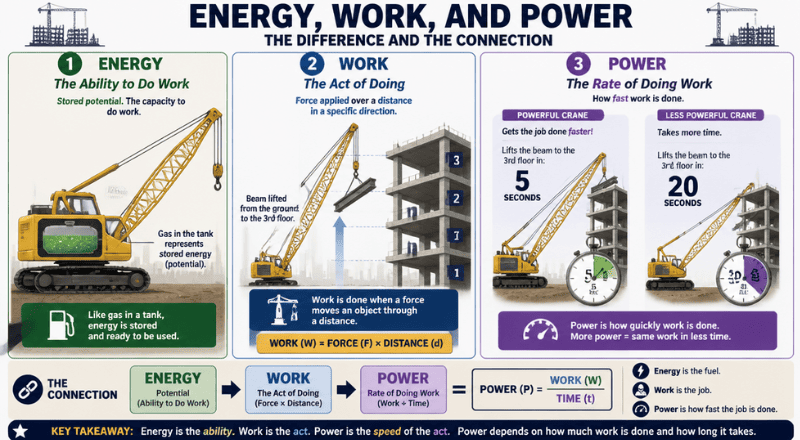
To master physics education, one must be able to categorise these concepts instantly. Think of a construction project:
- Energy is the gas in the crane’s tank. It represents the potential to perform the job.
- Work is when a crane lifts a steel beam from the ground up to the third floor. It is the result of the force applied over a distance.
- Power refers to the speed at which the crane’s motor operates. A more powerful crane can lift the beam in five seconds, while a less powerful one might take twenty seconds.
The difference between energy and work comes down to the “ability to do” versus the “act of doing”. On the other hand, the link between work and power is all about time—power is just the rate at which work is done.
How to Calculate Energy, Work, and Power
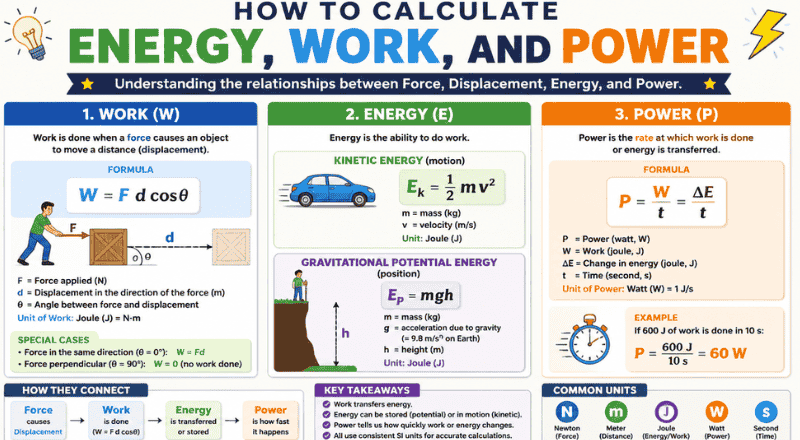
Grasping the formulas for energy, work, and power becomes simple once you understand the basic idea behind them.
Calculating Work
Work ($W$) is calculated by multiplying the Force ($F$) by the Displacement ($d$) and the cosine of the angle ($\theta$) between them: $W = F \cdot d \cdot \cos(\theta)$
This formula shows that work reaches its maximum when the force is applied exactly in the direction of motion.
Calculating Energy
Kinetic Energy ($KE$) is determined by mass ($m$) and velocity ($v$): $KE = \frac{1}{2}mv^2$
Gravitational Potential Energy ($PE$) is determined by mass ($m$), the acceleration due to gravity ($g \approx 9.8 m/s^2$), and height ($h$): $PE = mgh$
Calculating Power
Power ($P$) is the work performed ($W$) divided by the time ($t$) it took to perform it: $P = \frac{W}{t}$
Alternatively, since \(W = F \cdot d\), power can also be expressed as force multiplied by velocity \((P = F \cdot v)\). This way of calculating power is key to understanding both engine performance and athletic output.
Practical Examples of Energy Transformation
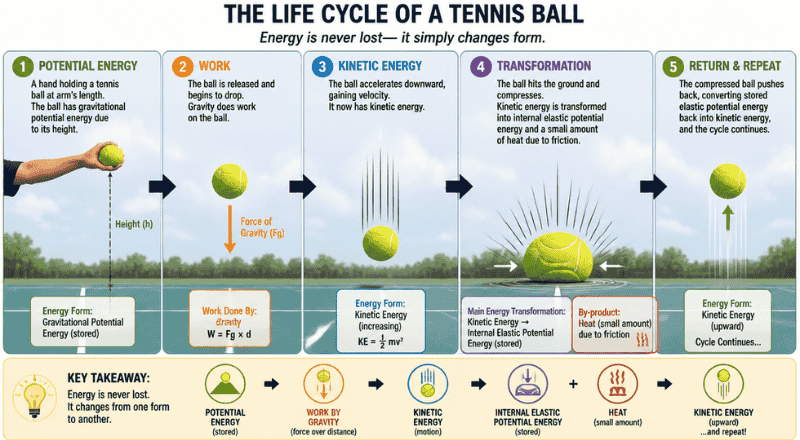
To truly grasp these energy concepts, consider the life cycle of a tennis ball:
- Potential Energy: You hold a tennis ball at arm’s length. It has potential energy due to its height.
- Work: You drop the ball. Gravity does work on the ball, pulling it downward and displacing it.
- Kinetic Energy: As the ball falls, its potential energy is converted into kinetic energy. It gains velocity.
- Transformation: Upon hitting the ground, the ball compresses. Some kinetic energy is transformed into internal elastic potential energy (deforming the ball) and a small amount of heat (thermal energy) due to friction.
This sequence perfectly illustrates how energy is never lost; it simply changes form, often facilitated by work and measured by power.
Why These Concepts Matter in Physics
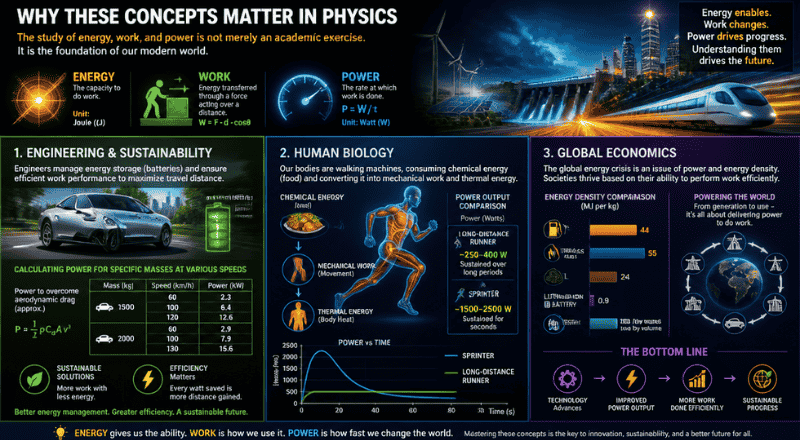
Learning about energy, work, and power isn’t just something for the classroom—it’s the backbone of how our modern world functions.
Engineering and Sustainability
When engineers design electric vehicles, they calculate the power required to move a specific mass at a specific speed. They need to manage battery storage and ensure tasks are completed efficiently to maximise travel distance.
Human Biology
Our bodies are walking machines. We consume chemical energy (food) and convert it into mechanical work (running, lifting) and thermal energy (body heat). Power output is a key metric in sports science, determining the difference between a long-distance runner (who manages energy output over time) and a sprinter (who generates massive power in a short window).
Global Economics
At a macro level, the global energy crisis is an issue of power and energy density. Societies thrive based on their ability to perform work efficiently. Every technological advancement, from the steam engine to renewable energy grids, is essentially an attempt to perform more work with less energy or to generate power more sustainably.
Conclusion
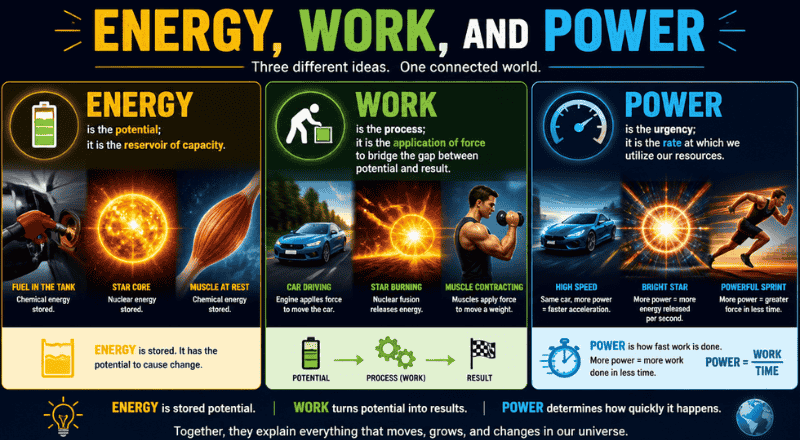
Understanding the differences between energy, work, and power helps us describe the physical world more clearly. When we look beyond everyday meanings, we can better grasp how cars move, how stars shine, and how our muscles operate.
- Energy is the potential; it is the reservoir of capacity.
- Work is the process; it is the application of force to bridge the gap between potential and result.
- Power is the urgency; it is the rate at which we utilise our resources.
As you progress in your physics journey, keep these relationships in mind. Whether you’re working through tricky equations or watching the world in motion, remembering the “confusing trio” can give you the clarity you need to tackle problems involving motion and force.
Click here to visit my page: Optical Illusion Quiz: 25 Questions to Explore the Mind’s Eye

Elevate your lifestyle with our curated content on technology, sports, travel, health, and fashion. Stay ahead of the trends and make informed choices.