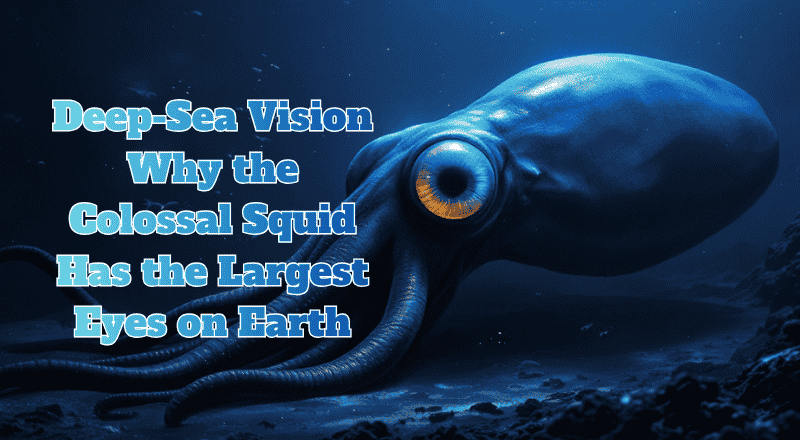
The ocean remains a final frontier of human discovery, covering over seventy percent of Earth. In its deepest realms, nature has engineered extraordinary biological adaptations, notably the colossal squid’s sensory capabilities. Found in the depths of the Southern Ocean, where biology is rewritten, this deep-sea titan possesses the largest eyes on Earth, showcasing extreme adaptation.
Studying these ocean giants highlights nature’s complexity, fostering appreciation for marine ecosystems and their deep-sea evolutionary arms race. Understanding why the colossal squid needs soccer-ball-sized eyes requires examining the abyssal zone through the lens of this elusive creature.
Anatomy of the Colossal Squid
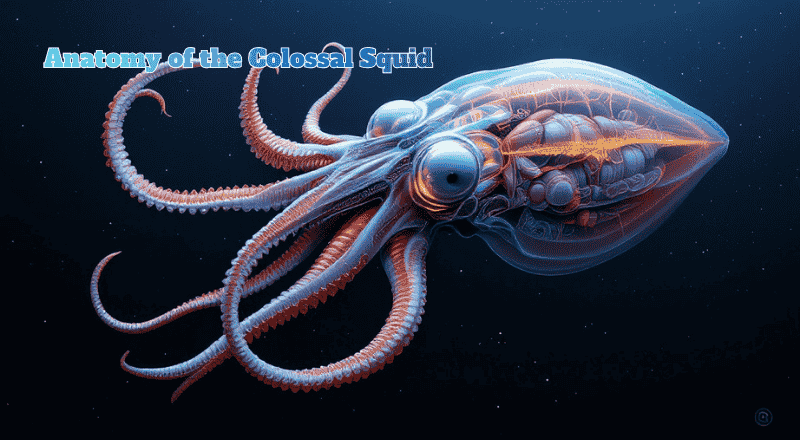
To appreciate the vision of the colossal squid, one must first understand the sheer scale of the animal itself. Scientifically known as Mesonychoteuthis hamiltoni, the colossal squid is a true heavyweight of the deep. While the more famous giant squid (Architeuthis dux) may reach slightly longer total lengths due to its exceptionally long feeding tentacles, the colossal squid is significantly bulkier and heavier. It is the largest known invertebrate on the planet, with some specimens estimated to weigh nearly 1,100 pounds.
The colossal squid’s anatomy is a masterclass in deep-sea survival. Its large, muscular mantle houses internal organs, including three hearts and a complex nervous system. Unlike squids with toothed suckers, it features rotating, razor-sharp hooks on its clubs and tentacles to grasp slippery prey and defend against its primary predator, the sperm whale.
However, it is the head and the eyes that truly captivate marine biologists. A colossal squid’s eye can measure up to 11 inches (27 centimetres) in diameter. To put that into perspective, their eyes are roughly the size of a standard basketball. This makes them the largest eyes ever recorded in the animal kingdom—larger even than those of the great blue whale. These massive orbs are positioned on the sides of the head, providing a wide field of view that is essential for navigating a world without boundaries.
Through convergent evolution, these cephalopod eyes structurally resemble vertebrate eyes, possessing a lens, iris, and retina. Unlike human eyes, they lack a “blind spot” because their nerve fibres route behind light-sensing cells. This anatomy is a vital survival advantage under the immense pressure and complete darkness of the Southern Ocean.
Vision in the Abyssal Zone
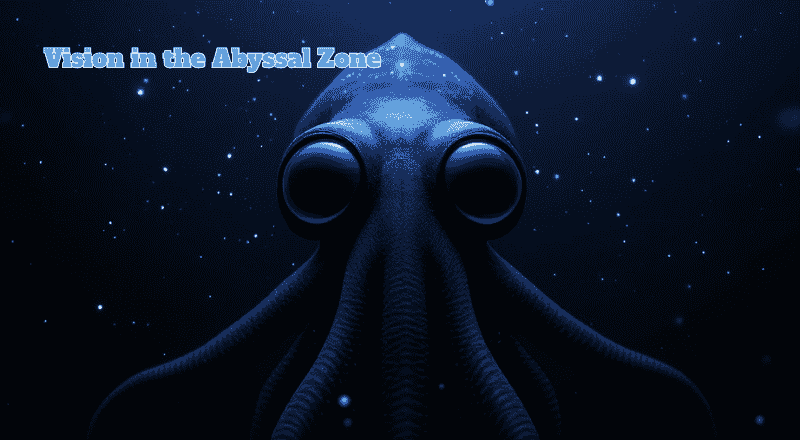
The colossal squid mainly lives in the abyssal zone and the mesopelagic depths of Antarctic waters, often diving to depths of more than 6,000 feet. At these levels, the environment is characterised by near-freezing temperatures and immense pressure that would crush most terrestrial life. Most importantly, it is a region of perpetual shadows. Sunlight, which fuels the surface world, is rapidly absorbed by the water column. By the time one reaches the depths where the colossal squid roams, 99% of sunlight has been filtered out.
Under such conditions, deep-sea vision becomes a specialised skill. In the upper layers of the ocean, eyes are used to see shapes silhouetted against the faint light from above. But in the deep-sea trenches, the game changes. Here, the “background” light is nonexistent. The evolution of the largest eyes on Earth was not driven by a need to see more sunlight but by the need to gather the tiniest fragments of light available in a void.
For many deep-sea creatures, the eyes are either non-existent or highly specialised. Some fish have tubular eyes that point upward to catch any stray photons. The colossal squid, however, took a different evolutionary path. By developing massive, wide-aperture eyes, it maximised its ability to detect contrast and motion. Large eyes allow for a larger pupil and a bigger lens, which catch more light. This larger surface area works like a wide-aperture camera lens, enabling the squid to see in conditions that would seem completely dark to a human diver.
Detecting Bioluminescence in Darkness
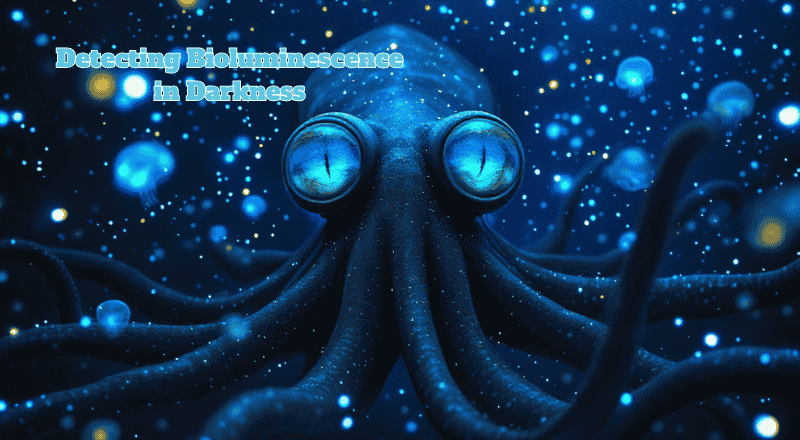
If there is no sunlight in the deep ocean, what is the colossal squid searching for? The answer lies in the mesmerising phenomenon of bioluminescence. The deep sea is not actually pitch black; it is punctuated by flashes of blue and green light produced by living organisms. This “living light” is used for communication, luring prey, and camouflage. In the abyssal zone, bioluminescence is the primary source of illumination.
Deep-sea creatures use bioluminescence in various ways. Some small fish and jellyfish use it as a “burglar alarm”. When a predator attacks them, they emit a bright flash of light to reveal the attacker to even larger predators. The colossal squid has evolved its massive eyes to capitalise on these flashes. While a smaller eye might miss a brief, faint glow in the distance, the colossal squid’s basketball-sized eyes act like high-powered telescopes.
One of the most fascinating theories regarding deep-sea vision suggests that the colossal squid uses its eyes specifically to detect the presence of its greatest foe: the sperm whale. Sperm whales are massive mammals that must dive deep to hunt squid. As a whale moves through the water, it inevitably disturbs tiny bioluminescent organisms like plankton and jellyfish. This movement creates a faint, glowing wake or a series of sparkles.
The colossal squid’s eyes are uniquely tuned to detect this “luminous turbulence”. By spotting the glowing outline of a moving whale from a significant distance—potentially over 100 yards away—the squid gains a vital few seconds to react. In the high-stakes world of the deep ocean, those few seconds can mean the difference between escaping into the darkness and becoming a whale’s next meal. This ability to detect bioluminescence is a testament to the incredible precision of marine biology.
Evolutionary Advantages of Giant Eyes
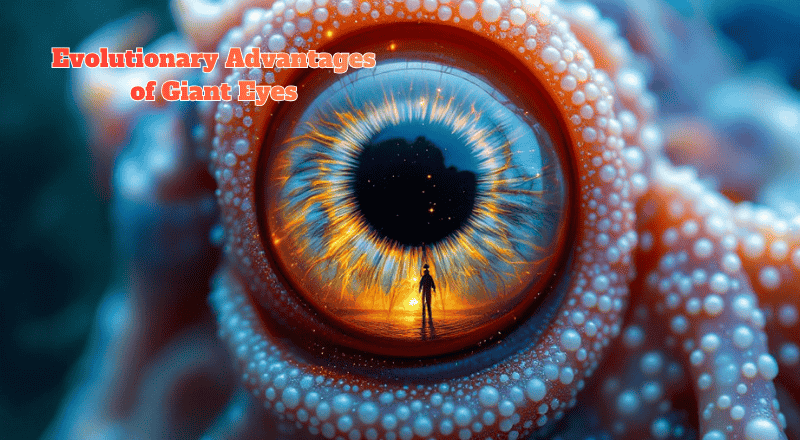
The question often arises: if big eyes are so useful, why don’t all deep-sea animals have them? The answer lies in the cost of biological “real estate”. Large eyes are incredibly expensive to build and maintain. They require a significant amount of energy to power the photoreceptors and the neural processing power to interpret the data. For many smaller species, the energy cost of giant eyes would outweigh the survival benefits.
In the case of squid evolution, however, the investment paid off. The colossal squid occupies a unique niche as both a top-tier predator and a prey item for one of the world’s largest mammals. To maintain its massive body, it needs to hunt efficiently while avoiding predation. The giant eyes provide an evolutionary advantage that justifies their energy consumption.
These eyes allow for superior “point-source” detection. In the vast, open water, there are no trees or rocks to hide behind. Space is three-dimensional and infinite. Having the largest eyes on Earth gives the colossal squid a superior “radar” system. It can scan the water for the faint silhouettes of fish or other squid, allowing it to strike with its powerful tentacles before the prey even knows it is there.
Furthermore, the evolution of giant eyes is linked to the squid’s metabolism. Colossal squids are believed to be “sit-and-wait” predators rather than active chasers. They drift in the water, conserving energy and using their superior vision to wait for an opportunity. In this low-energy lifestyle, having an exceptional sensory system is more efficient than having the muscles for high-speed chasing. The eyes do the hard work of scouting, allowing the rest of the body to remain still and unnoticed.
Comparing Giant and Colossal Squids
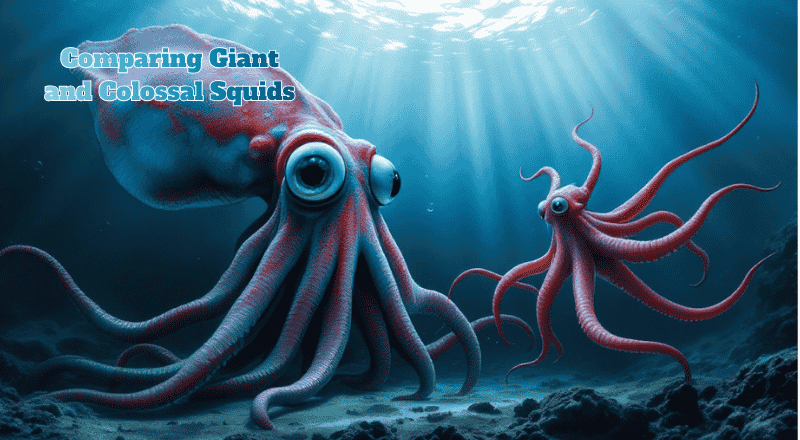
In the realm of ocean giants, the giant squid and the colossal squid are often confused, yet they represent different branches of cephalopod success. While both possess the largest eyes on earth, they have adapted to different environments and hunting styles.
The giant squid (Architeuthis) is found in oceans worldwide and tends to have a more slender profile. Its tentacles are incredibly long, designed to snatch prey from a distance. Its eyes are similarly large, as it also faces predation from sperm whales in more temperate waters. However, the giant squid’s eyes are slightly smaller on average than those of its colossal cousin.
The colossal squid (Mesonychoteuthis) is a specialist of the cold Antarctic waters. Because cold water holds more oxygen and supports different types of prey, the colossal squid grew to be much heavier. Its anatomy is more robust, and its eyes are even more specialised for the specific light conditions of the Southern Ocean.
Interestingly, both species use their eyes to solve the same problem: seeing a predator before the predator sees them. Sperm whales use echolocation (sonar) to find squid in the dark. Sonar is incredibly effective, but it has a limit. The squid cannot “hear” the sonar in the same way, but they can “see” the visual disturbance the whale makes. This creates a fascinating biological standoff. The whale uses sound to see, while the squid uses light to “hear” the whale’s movement. This comparison highlights how different evolutionary paths can lead to a similar goal: survival in the most extreme environments on the planet.
Survival Adaptations in the Deep Sea
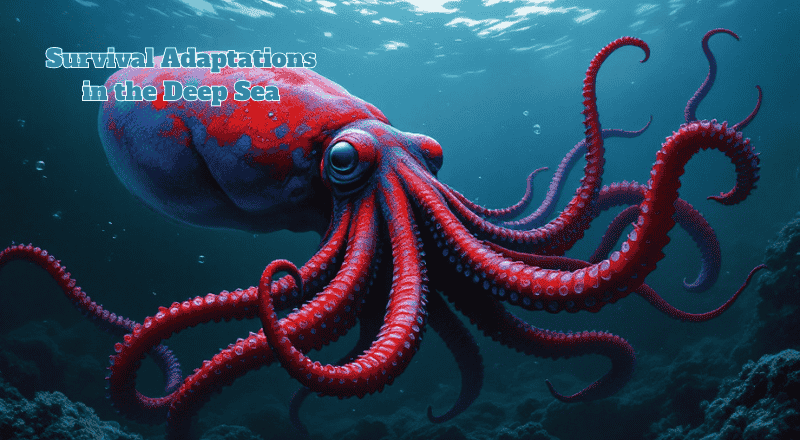
Beyond their vision, colossal squids possess a suite of survival adaptations that make them the kings of the abyssal zone. One of the most remarkable is their use of neutral buoyancy. Instead of constantly swimming to stay afloat, the colossal squid maintains a high concentration of ammonium chloride in its tissues. This chemical is lighter than seawater, allowing the squid to float effortlessly. This conservation of energy is crucial in a place where food can be scarce.
Their skin is also a marvel of deep-sea engineering. Like many cephalopods, they possess chromatophores—pigment-containing cells—that allow them to change colour. In the deep sea, being red is actually a form of camouflage. Because red light is the first to be filtered out by water, appearing red makes the squid virtually invisible to any creature that doesn’t have specialised light-sensing equipment. To a predator, a red squid in the deep ocean looks black.
We must also consider their unique hunting tools. The colossal squid’s tentacles are equipped with swivelling hooks. These are not merely for show; they can rotate 360 degrees, allowing the squid to latch onto prey from any angle. Once caught, the prey is pulled toward a powerful beak, made of hard chitin, which can shear through bone and muscle with ease.
The combination of these adaptations—neutral buoyancy, camouflage, lethal weaponry, and the largest eyes on Earth—creates a creature that is perfectly tuned to its environment. It reminds us that “monsters” of the deep are not chaotic beings but rather highly organised, efficient, and beautiful examples of life’s resilience. Each part of the squid’s anatomy serves a purpose, contributing to the survival of beings but remaining a morganised one for centuries.
The Importance of Deep-Sea Research
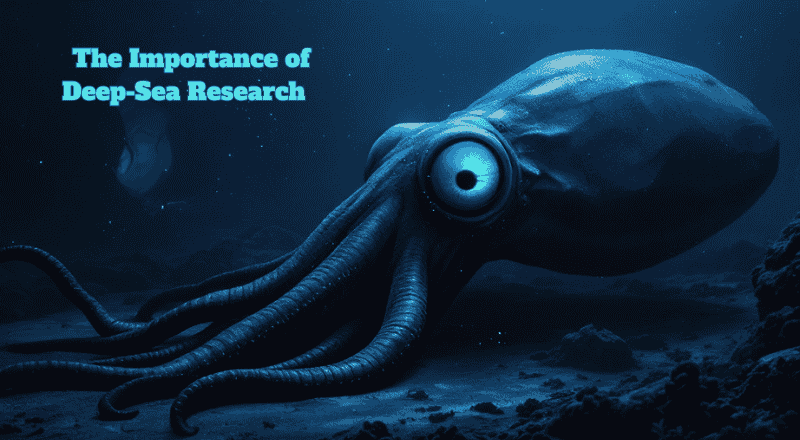
The study of the colossal squid is a relatively young field. For a long time, our only knowledge of these creatures came from the remains found in the stomachs of sperm whales or the occasional carcass that washed ashore. It wasn’t until 2007 that a complete, live specimen was captured by a fishing vessel in the Ross Sea, providing scientists with an unprecedented opportunity to study its anatomy in detail.
Every discovery about the colossal squid and its deep-sea vision opens a window into the health of our oceans. As top predators, these squids are indicators of the vitality of the Southern Ocean’s food web. Protecting their habitat is not just about saving a single species; it is about preserving the mysterious and complex ecosystems that regulate our planet’s climate and biodiversity.
Understanding how these creatures see in the dark also has applications beyond marine biology. Engineers and physicists study the structure of cephalopod eyes to improve camera technology and light-sensitive sensors. Nature has had millions of years to perfect “low-light photography”, and we are only just beginning to learn its secrets.
A Vision of Wonder
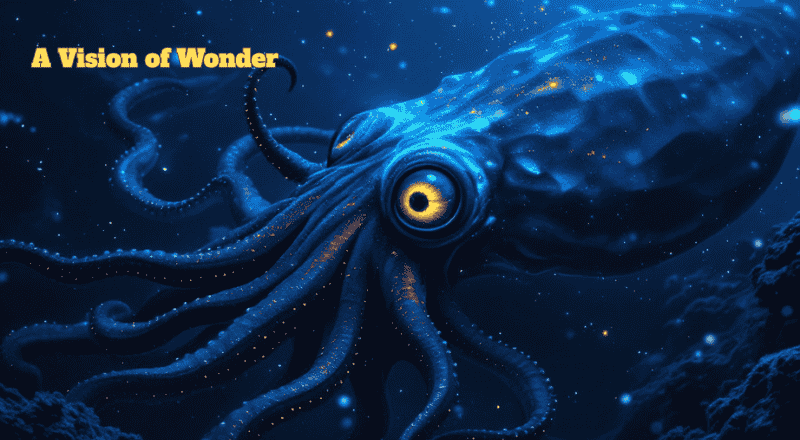
In the end, the story of the colossal squid’s eyes is a story of light in the darkness. It is an encouraging reminder that even in the most inhospitable places, life finds a way to thrive, to see, and to adapt. The largest eyes on Earth are not just biological oddities; they are symbols of the vast, unexplored wonders that still exist in our world.
As we continue to explore the deep sea, we are humbled by the realisation of how little we know. The colossal squid challenges our perceptions of what is possible, pushing the boundaries of size, strength, and sensory perception. It stands as a guardian of the abyss, a testament to the power of evolution, and a call to all of us to remain curious about the hidden corners of our blue planet.
By protecting our oceans and supporting marine research, we ensure that the mystery of the colossal squid continues to inspire future generations of scientists and nature enthusiasts. The deep sea may be dark, but through the eyes of the colossal squid, we can begin to see the incredible beauty and complexity that lies beneath the waves. Whether it is through the detection of bioluminescence or the silent dance of a predator in the shadows, the colossal squid remains one of the most fascinating characters in the grand story of life on Earth.
Click here: Please visit our page. The Oceans: Our Planet’s Blue Heart

Elevate your lifestyle with our curated content on technology, sports, travel, health, and fashion. Stay ahead of the trends and make informed choices.