
- The Power of Active Listening: Why Listening Is 90% of Effective Communication
- Why Active Listening Matters More Than You Think
- Core Components of Active Listening
- Practical Active Listening Techniques for Leaders (communications)
- Active Listening Exercises to Strengthen Your Skill Set
- How Active Listening Fuels Professional Growth
- Integrating Active Listening Into Your Daily Workflow
The Power of Active Listening: Why Listening Is 90% of Effective Communication
In today’s fast‑paced business world, the ability to speak persuasively often steals the spotlight—yet the true engine behind influence, collaboration, and leadership is active listening. Research consistently shows that when we truly hear others, we unlock up to 90% of the value in any conversation. This blog explores why active listening is the cornerstone of effective communications in the workplace, offers practical listening techniques for leaders, and shares actionable active listening exercises you can start using today to boost your professional growth and workplace soft skills.
Why Active Listening Matters More Than You Think
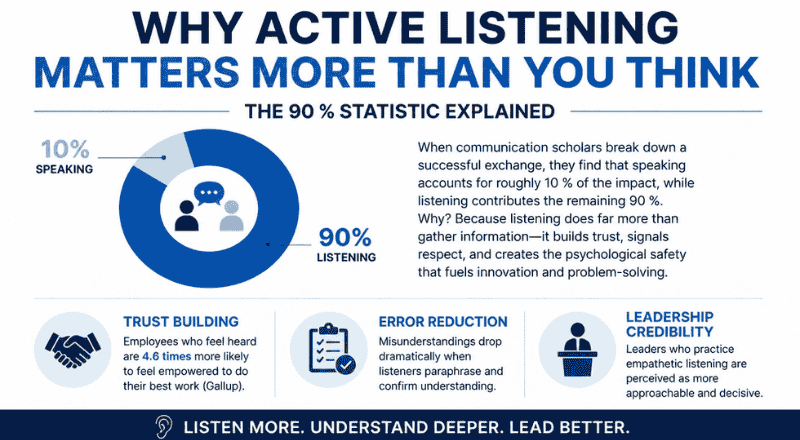
The 90% Statistic Explained
When communications scholars break down a successful exchange, they find that speaking accounts for roughly 10% of the impact, while listening contributes the remaining 90%. Why? Because listening does far more than gather information—it builds trust, signals respect, and creates the psychological safety that fuels innovation and problem‑solving.
- Trust Building: Employees who feel heard are 4.6 times more likely to feel empowered to do their best work (Gallup).
- Error Reduction: Misunderstandings drop dramatically when listeners paraphrase and confirm understanding.
- Leadership Credibility: Leaders who practise empathetic listening are perceived as more approachable and decisive.
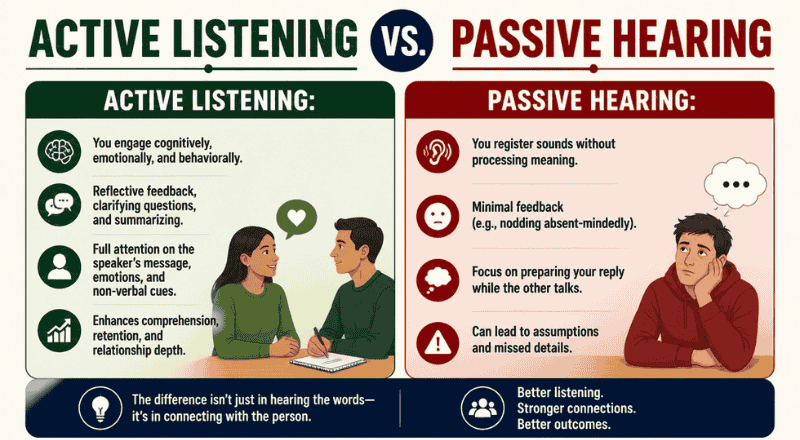
Active Listening vs. Passive Hearing (communications)
|
Passive Hearing |
Active Listening |
|
You register sounds without processing meaning. |
You engage cognitively, emotionally, and behaviourally. |
| Minimal feedback (e.g., nodding absentmindedly). |
Reflective feedback, clarifying questions, and summarising. |
|
Focus on preparing your reply while the other talks. |
Full attention on the speaker’s message, emotions, and non‑verbal cues. |
|
Can lead to assumptions and missed details. |
Enhances comprehension, retention, and relationship depth. |
Understanding this distinction is the first step toward mastering active listening skills that translate directly into improved communication skills at work.
Core Components of Active Listening
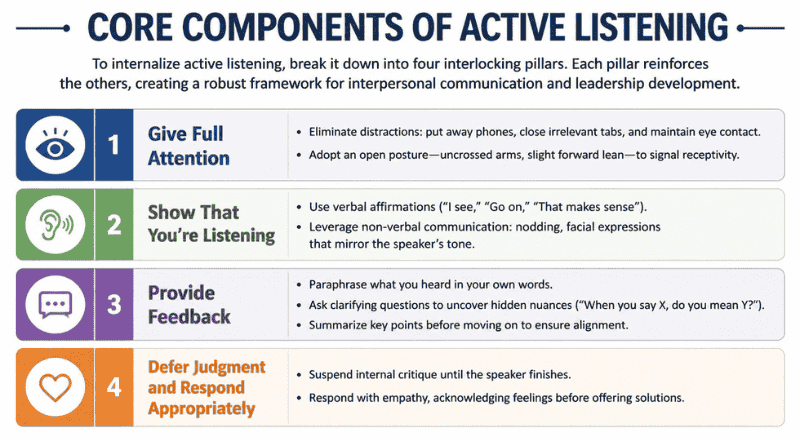
To internalise active listening, break it down into four interlocking pillars. Each pillar reinforces the others, creating a robust framework for interpersonal communications and leadership development.
-
Give Full Attention
-
- Eliminate distractions: put away phones, close irrelevant tabs, and maintain eye contact.
- Adopt an open posture—uncrossed arms, slight forward lean—to signal receptivity.
-
Show That You’re Listening
-
- Employ short vocal cues, such as “I understand”, “continue”, or “that is clear”, to show attentive engagement.
- Leverage non‑verbal communications: nodding, facial expressions that mirror the speaker’s tone.
-
Provide Feedback
-
- Paraphrase what you heard in your own words.
- Ask clarifying questions to uncover hidden nuances (“When you say X, do you mean Y?”).
- Summarise key points before moving on to ensure alignment.
-
Defer Judgement and Respond Appropriately
-
- Suspend internal critique until the speaker finishes.
- Respond with empathy, acknowledging feelings before offering solutions.
Practical Active Listening Techniques for Leaders (communications)
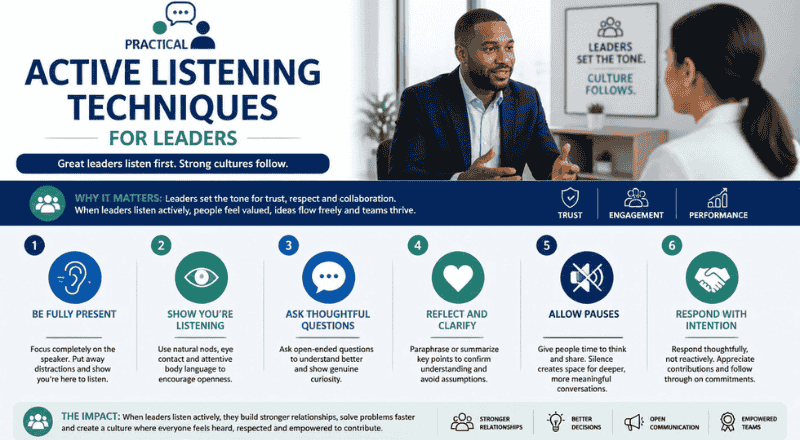
Leaders set the tone for organisational culture. By modelling listening techniques for leaders, you inspire teams to adopt the same habits, amplifying collective performance.
Technique 1: The “3‑Second Pause”
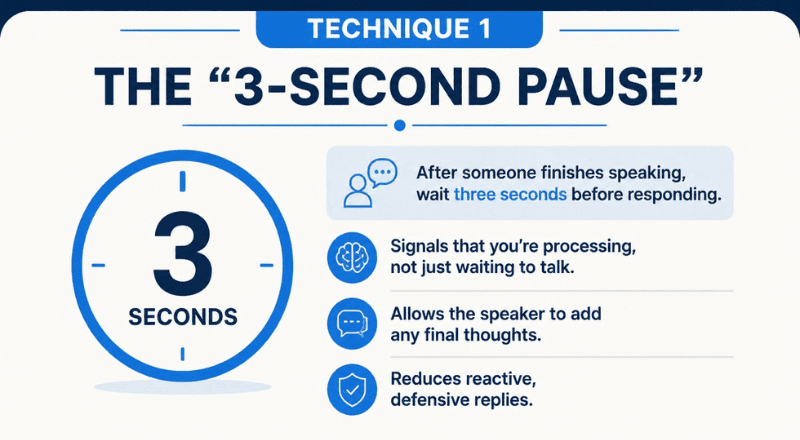
After someone finishes speaking, wait three seconds before responding. This brief silence:
- Demonstrates that you are truly comprehending the message rather than merely anticipating your turn to speak.
- Allows the speaker to add any final thoughts.
- Reduces reactive, defensive replies.
Technique 2: Mirroring & Labelling
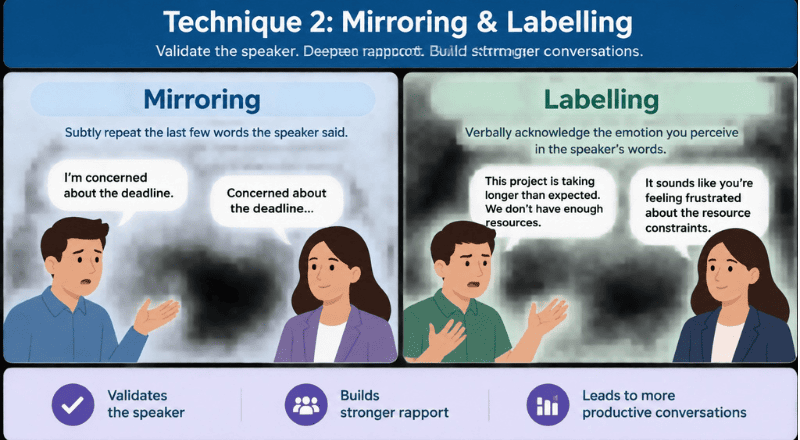
- Mirroring: Subtly repeat the last few words the speaker said (e.g., if they say, “I’m concerned about the deadline,” you respond, “Concerned about the deadline…”).
- Labelling: Verbally acknowledge the emotion you perceive (“It sounds like you’re feeling frustrated about the resource constraints”).
- Both techniques validate the speaker and deepen rapport.
Technique 3: The “Listen‑Learn‑Lead” Loop
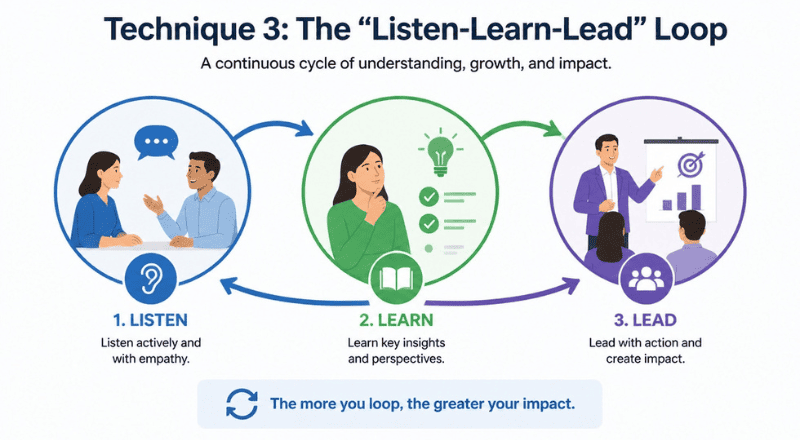
- Listen actively using the pillars above.
- Learn by extracting insights, identifying patterns, and noting unspoken needs.
- Lead by translating those insights into clear actions, decisions, or supportive feedback.
Repeating this loop in meetings, one‑on‑ones, and informal chats transforms routine exchanges into strategic opportunities.
Active Listening Exercises to Strengthen Your Skill Set
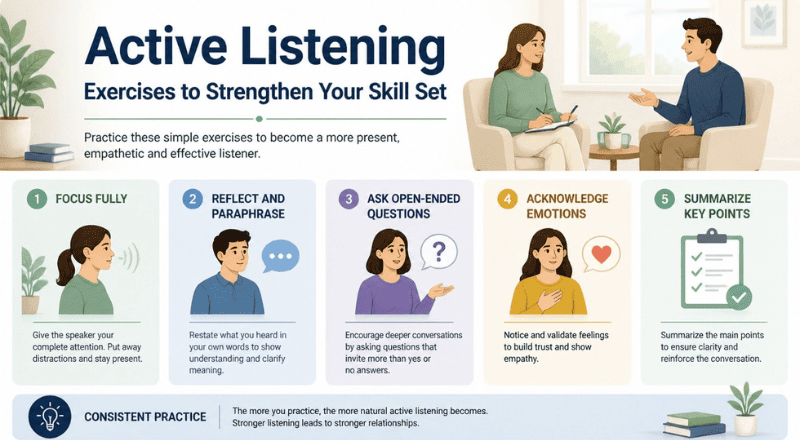
Like any muscle, listening improves with deliberate practice. Incorporate these active listening exercises into your weekly routine to see measurable gains in professional communication tips and overall workplace soft skills.
Daily Reflective Journaling
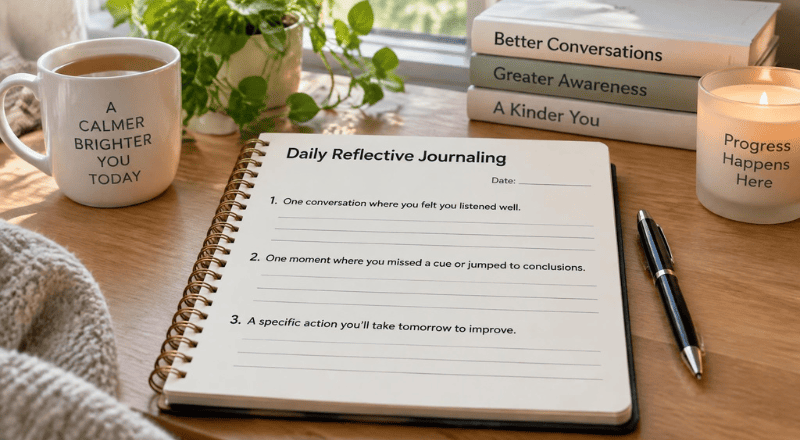
- As your shift wraps up, take a quick five-minute pause to reflect and log your daily thoughts:
-
- One conversation where you felt you listened well.
- One moment where you missed a cue or jumped to conclusions.
- A specific action you’ll take tomorrow to improve.
Reviewing this journal weekly highlights patterns and tracks progress.
Partner Role‑Play (10‑Minute Drill)
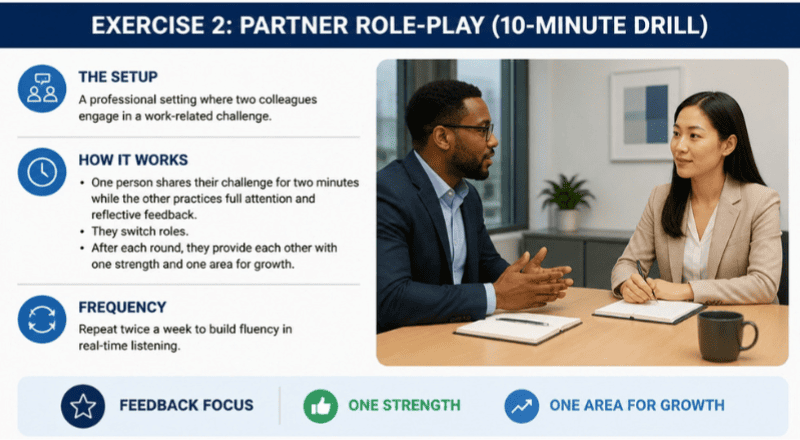
- Pair with a colleague. One person shares a work‑related challenge for two minutes while the other practises full attention and reflective feedback.
- Switch roles. After each round, give each other one strength and one area for growth.
- Repeat twice a week to build fluency in real‑time listening.
Non‑Verbal Observation
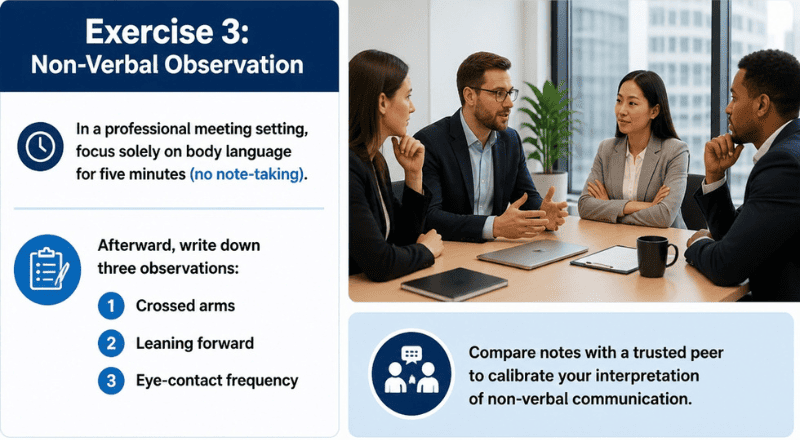
- In a meeting, focus solely on body language for five minutes (no note‑taking).
- Afterward, write down three observations (e.g., crossed arms, leaning forward, eye‑contact frequency).
- Compare notes with a trusted peer to calibrate your interpretation of non‑verbal communication.
The “Listening Walk”
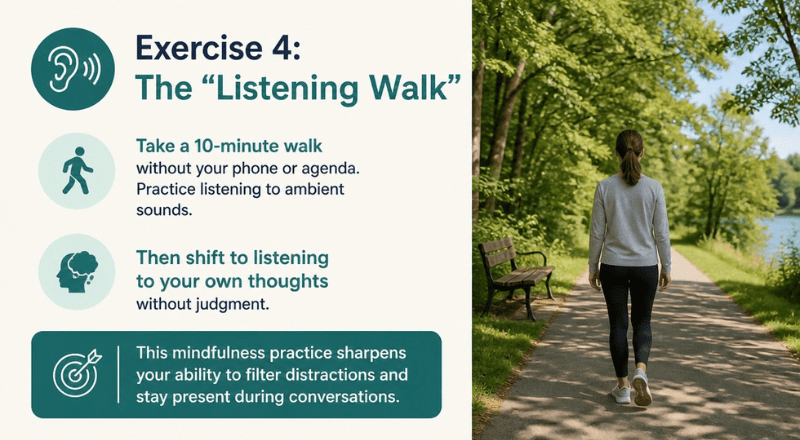
- Take a 10‑minute walk without your phone or agenda.
- Practice listening to ambient sounds, then shift to listening to your own thoughts without judgement.
- This mindfulness practice sharpens your ability to filter distractions and stay present during conversations.
How Active Listening Fuels Professional Growth
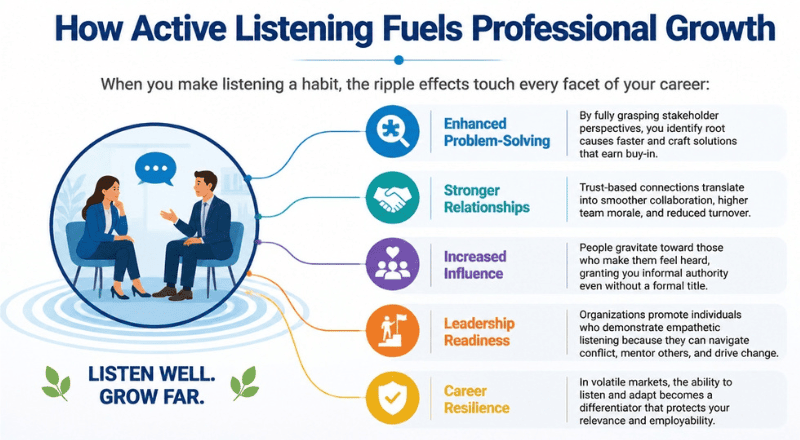
When you make listening a habit, the ripple effects touch every facet of your career:
- Enhanced Problem‑Solving: By fully grasping stakeholder perspectives, you identify root causes faster and craft solutions that earn buy‑in.
- Stronger Relationships: Trust‑based connections translate into smoother collaboration, higher team morale, and reduced turnover.
- Increased Influence: People gravitate toward those who make them feel heard, granting you informal authority even without a formal title.
- Leadership Readiness: Organisations promote individuals who demonstrate empathetic listening because they can navigate conflict, mentor others, and drive change.
- Career Resilience: In volatile markets, the ability to listen and adapt becomes a differentiator that protects your relevance and employability.
Integrating Active Listening Into Your Daily Workflow
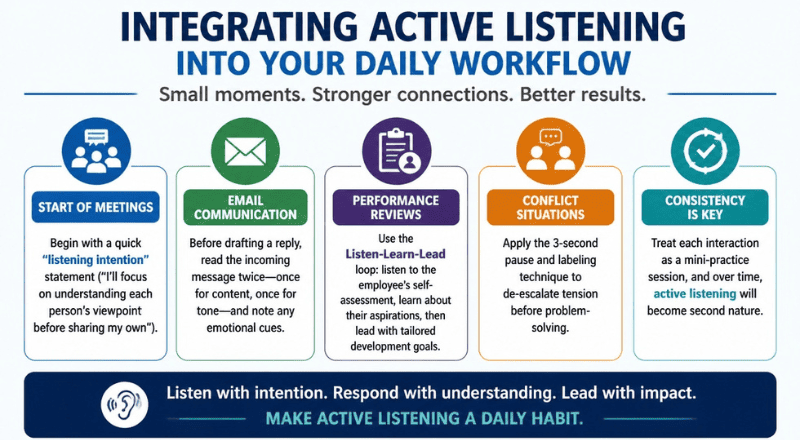
To move from theory to habit, embed listening checkpoints into existing routines:
- Start of Meetings: Begin with a quick “listening intention” statement (“I’ll focus on understanding each person’s viewpoint before sharing my own”).
- Email Communication: Before drafting a reply, read the incoming message twice—once for content, once for tone—and note any emotional cues.
- Performance Reviews: Use the Listen‑Learn‑Lead loop: listen to the employee’s self‑assessment, learn about their aspirations, then lead with tailored development goals.
- Conflict Situations: Apply the 3‑second pause and labelling technique to de‑escalate tension before problem‑solving.
Consistency is key. Treat each interaction as a mini‑practice session, and over time, active listening will become second nature.
Click here: communication skills 8 tips for growth in the right way
Frequently Asked Questions About Active Listening
Q1: Can active listening be learned, or is it an innate trait?
A: While some individuals may have a natural inclination toward attentiveness, active listening is a skill that improves with deliberate practice, feedback, and self‑awareness.
Q2: How does active listening differ from simply being quiet?
A: Being quiet may indicate you’re not interrupting, but active listening involves engaged processing, reflective feedback, and responsive behaviour—far beyond silence.
Q3: What if I’m in a fast‑paced environment where pausing feels unnatural?
A: Start small—use the 3‑second pause after the first sentence of each exchange. Gradually extend the pause as you become comfortable; the perceived awkwardness diminishes with repetition.
Q4: How do I measure improvement in my listening skills?
A: Track metrics such as reduced follow‑up clarification requests, increased positive feedback in 360‑reviews, and higher scores on interpersonal communication assessments.

Elevate your lifestyle with our curated content on technology, sports, travel, health, and fashion. Stay ahead of the trends and make informed choices.