Why are leaves green?
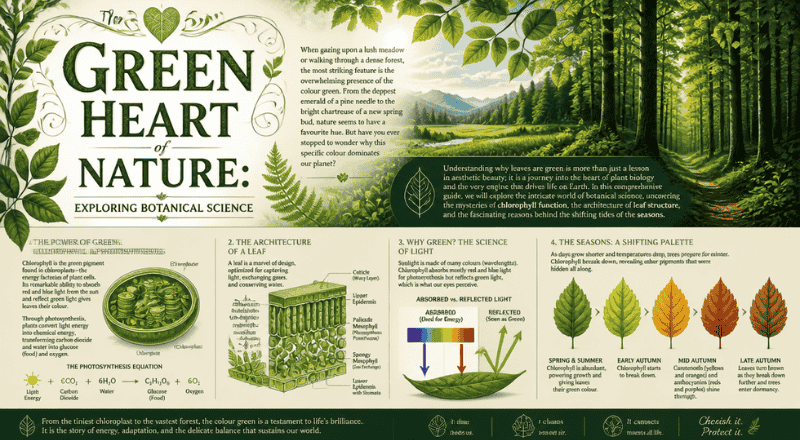
When gazing upon a lush meadow or walking through a dense forest, the most striking feature is the overwhelming presence of the colour green. From the deepest emerald of a pine needle to the bright chartreuse of a new spring bud, nature seems to have a favourite hue.
Understanding why leaves are green is more than just a lesson in aesthetic beauty. It is a journey into the heart of plant biology and the very engine that drives life on Earth. In this comprehensive guide, we will explore the intricate world of botanical science, uncovering the mysteries of chlorophyll function, the architecture of leaf structure, and the fascinating reasons behind the shifting tides of the seasons.
- The Role of Chlorophyll: Nature’s Primary Pigment
- Understanding Chloroplasts: The Solar Factories of the Cell
- The Science of Light Absorption: Why Green?
- How Photosynthesis Works: The Engine of Life (Why are leaves green?)
- Why Leaves Change Colour: The Autumn Transformation
- The Importance of Botanical Science in Our Daily Lives
- Encouraging Your Inner Naturalist
- Conclusion: A World Driven by Green
The Role of Chlorophyll: Nature’s Primary Pigment
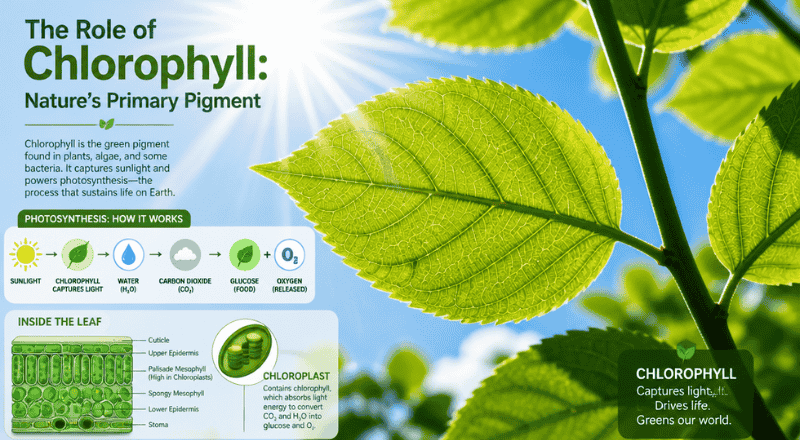
The question “Why are leaves green?” is fundamentally important. lies a remarkable molecule called chlorophyll. This green leaf pigment is the lifeblood of the plant kingdom. Without it, the world would be a desolate, oxygen-starved place. Chlorophyll is not just a colouring agent; it is a sophisticated biochemical tool designed to capture the power of the sun.
What is chlorophyll?
Chlorophyll is a pigment found in the tissues of plants, algae, and even some bacteria. The name comes from the Greek words “chloros”, meaning green, and “phyllon”, meaning leaf. Physically, the chlorophyll molecule is composed of a porphyrin ring. A structure similar to the heme group found in human red blood cells. Still, instead of iron at the centre, chlorophyll contains a magnesium atom. This tiny atomic difference is what allows plants to process sunlight rather than oxygen.
Chlorophyll a and b: The Dynamic Duo
In the world of botanical science, we distinguish between two primary types of this pigment: chlorophyll a and b.
Chlorophyll a: This is the most essential pigment involved in the photosynthesis process. It is directly responsible for converting light energy into chemical energy. It mainly absorbs light in the blue-violet and red parts of the spectrum.
Chlorophyll b: This is an accessory pigment. Its job is to expand the range of light a plant can use. It captures light energy at wavelengths different from chlorophyll a and transfers it to chlorophyll a to enhance efficiency.
By having both types, plants can maximise their light energy absorption, ensuring that they are as productive as possible even in shaded or overcast conditions.
Understanding Chloroplasts: The Solar Factories of the Cell
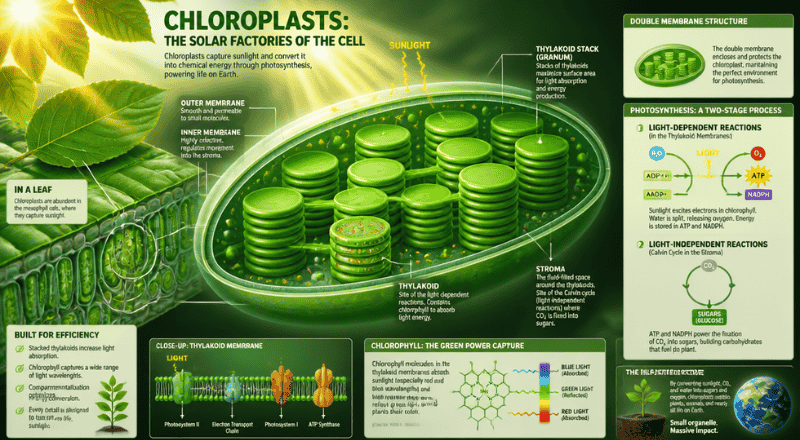
To understand how chlorophyll works, we must look at where it lives. Chlorophyll doesn’t just float freely within a leaf; it is housed in specialised organelles called chloroplasts. If a leaf is a factory, the chloroplasts are the machines on the assembly line.
The Architecture of a Chloroplast
Chloroplasts, explained simply, are the “solar panels” of the plant cell. Each leaf cell can contain anywhere from 10 to 100 chloroplasts, depending on the plant species and its environment. Inside these tiny green capsules, there is a complex internal structure:
- Thylakoids: These disc-shaped membranes, stacked in grana, house chlorophyll molecules within thylakoid membranes to absorb photons.
- Stroma: This is a dense fluid surrounding the thylakoids. It is here that the plant builds sugar molecules out of carbon dioxide and water.
- Double Membrane: Like a high-security facility, chloroplasts have two membranes that regulate what enters and exits the organelle.
Concentrating chlorophyll in these structures ensures organised, efficient photosynthesis. The flat, broad leaf structure maximises chloroplast exposure to sunlight.
The Science of Light Absorption: Why Green?
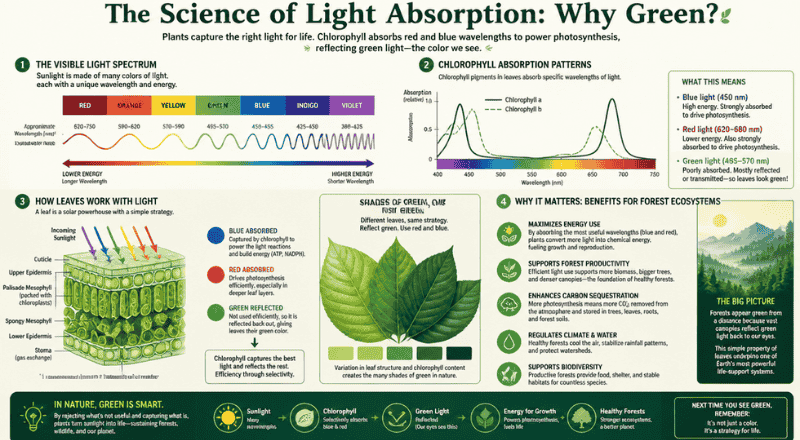
The most common question regarding plant science facts is, “If plants need light to grow. Why do they reflect the green light instead of using it?” To tackle this question, we’ll take a close look at the basic principles of light in physics.
The Visible Light Spectrum
Light from the sun arrives as a mixture of all the colours of the rainbow: red, orange, yellow, green, blue, indigo, and violet. Each colour has a unique wavelength. Objects appear a specific colour by reflecting that wavelength of light and absorbing others.
Chlorophyll Absorption Patterns
Chlorophyll absorption is highly selective. The chlorophyll molecule is “tuned” to favour the high-energy blue wavelengths and the lower-energy red wavelengths. These are the most efficient parts of the spectrum for driving the chemical reactions of life.
However, chlorophyll is not very good at absorbing light in the green part of the spectrum. Instead of being absorbed, this green light is reflected to our eyes or transmitted through the leaf. This is exactly why our leaves are green. They are essentially “rejecting” the green light, using the reds and blues to fuel their growth.
How Photosynthesis Works: The Engine of Life (Why are leaves green?)
Now that we know what makes a leaf green and where that pigment lives. We can explore the photosynthesis process itself. This is the biological miracle that turns sunlight into food.
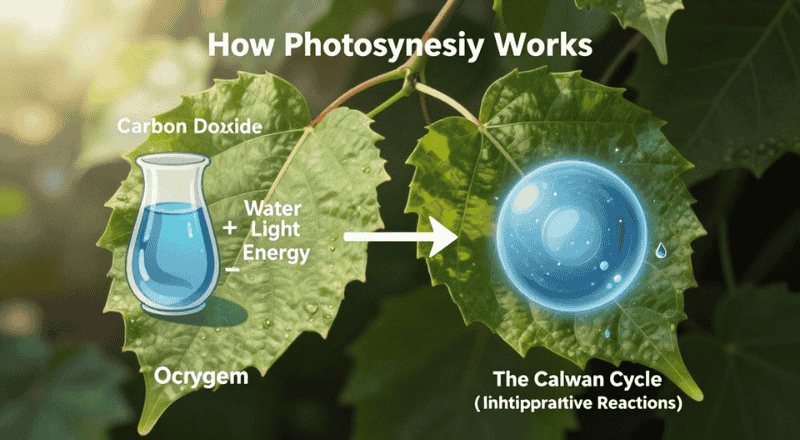
The Chemical Formula
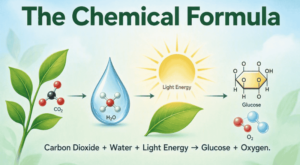
In its simplest form, photosynthesis can be summarised by this equation: Carbon Dioxide + Water + Light Energy → Glucose + Oxygen.
The Two Stages of Photosynthesis
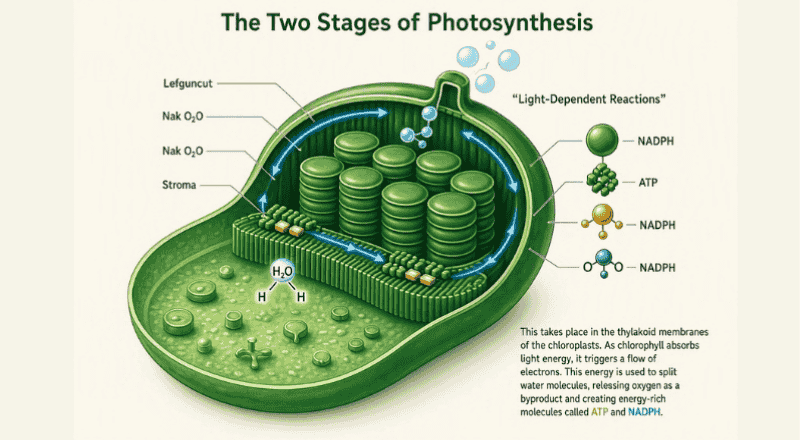
- The Light-Dependent Reactions: This takes place in the thylakoid membranes of the chloroplasts. As chlorophyll absorbs light energy, it triggers a flow of electrons. This energy is used to split water molecules, releasing oxygen as a byproduct (the oxygen we breathe!) and creating energy-rich molecules called ATP and NADPH.
- The Calvin Cycle (Light-Independent Reactions): This takes place in the stroma. The plant uses the energy stored in ATP and NADPH to “fix” carbon dioxide from the air, turning it into glucose (sugar). This glucose serves as the primary food source for the plant, used to build stems, roots, and flowers.
This complex interaction is the foundation of the entire plant life cycle. Without this ability to convert light into matter, there would be no food for herbivores, and consequently, no food for predators.
Why Leaves Change Colour: The Autumn Transformation
One of the most beautiful spectacles in nature is the transformation of green forests into seas of red, orange, and gold. If chlorophyll makes leaves green, why do leaves change colour in the fall?

The Retreat of Chlorophyll
As the days grow shorter and temperatures drop, plants begin to prepare for winter. For deciduous trees, this means entering a period of dormancy. Maintaining chlorophyll is an “expensive” process for a plant; it requires a lot of energy and nutrients.
As the plant life cycle moves toward winter, the tree stops producing chlorophyll. The existing chlorophyll begins to break down and disappear from the leaves.
Revealing Hidden Talents
When the dominant green of the chlorophyll fades.
- Carotenoids: These pigments produce yellow and orange colours (the same pigments found in carrots and corn). They assist in photosynthesis and protect the leaf from damage.
- Anthocyanins: These are produced in the fall, especially when days are sunny and nights are cool. They create the brilliant reds and purples we see in maples and oaks. They act as a “sunscreen” for the leaf as it shuts down, protecting the remaining nutrients.
The vibrant fall foliage is nature’s way of recycling.
The Importance of Botanical Science in Our Daily Lives
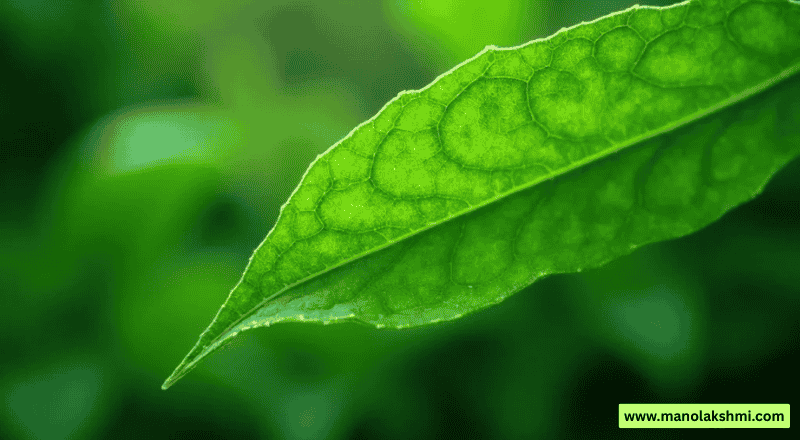
Looking at the green leaf pigment through the lens of science helps us appreciate the delicate balance of our ecosystem. Plants are powerful, living organisms that are essential for sustaining our planet’s atmosphere. They do not exist merely as background scenery; their active role is vital in maintaining the ecological balance of our environment.
Oxygen Production and Carbon Sequestration
Every green leaf is an air purifier. By absorbing carbon dioxide—a major greenhouse gas—and releasing oxygen, plants regulate the Earth’s climate. The more we understand about chlorophyll function and plant biology, the better we can protect our natural world from the threats of deforestation and climate change.
Agriculture and Food Security
Humanity depends on the photosynthesis process for survival. Our crops—wheat, rice, corn, and vegetables—are all green machines. By studying how different plants optimise light energy absorption. Scientists can develop more resilient crops that can grow in difficult climates, ensuring food security for a growing global population.
Encouraging Your Inner Naturalist
Understanding the science behind the greenery adds a layer of wonder to every walk in the park. The next time you see a leaf, you aren’t just seeing a piece of a plant; you are seeing a sophisticated solar-powered engine, a chemical laboratory, and a vital link in the global food chain.
Nature explained through science doesn’t lose its magic; it gains depth. The seasonal drama of why leaves change colour; there is always something new to discover in the backyard.
Tips for Observing Plant Science at Home:
- Look closely at the veins: the “veins” in a leaf are the transport system (xylem and phloem) that bring water to the chloroplasts and take sugar away.
- Observe the underside: the bottom of a leaf is often a lighter green and contains tiny pores called stomata, which allow the plant to “breathe” carbon dioxide.
- Watch the shadows: notice how plants move their leaves throughout the day to maximise sunlight exposure—a behaviour called phototropism.
Conclusion: A World Driven by Green
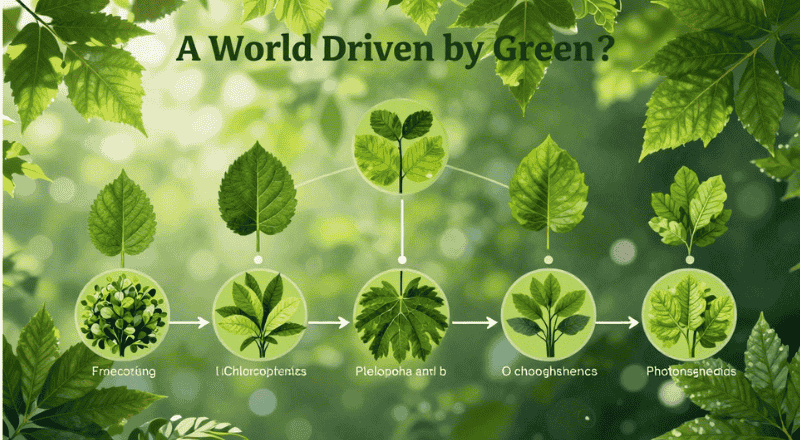
The question “What gives leaves their green colour?” opens the door to a vast world of botanical science. From the molecular structure of chlorophyll a and b to the grand scale of the plant life cycle, the colour green is a sign of a healthy, functioning planet.
By appreciating the role of chlorophyll absorption and the intricate photosynthesis process, we gain a deeper respect for the natural world. Plants are the silent guardians of life, turning sunlight into the very air we breathe and the food we eat. Remember the incredible biological “miracles” happening inside every single leaf.
Stay curious, keep exploring, and never stop asking why the world is as beautiful and complex as it is!

Elevate your lifestyle with our curated content on technology, sports, travel, health, and fashion. Stay ahead of the trends and make informed choices.